
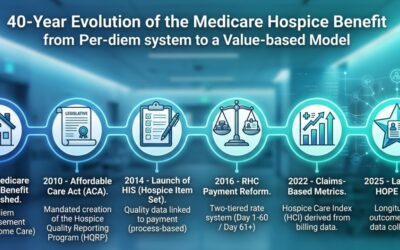
Understanding HQRP: The History of Hospice Quality
Hospice care, since its inception, has been about compassionate care. However, the underlying mechanisms of how it is paid for and how hospice quality is evaluated have undergone a significant transformation. This shift is part of a broader healthcare movement towards...

How to Master the Hospice CBR for Better Compliance
Many hospice administrators are familiar with the hospice PEPPER report. A smaller number of hospice leaders, however, are familiar with its counterpart: the Comparative Billing Report (CBR) and eCBR, the electronic version of the Comparative Billing Report. While the...

QAPI Documentation: How to Show Your Program is Active and Effective
Hospice leaders often understand that QAPI is required by CMS, but many do not know how to document the program in a way that proves it is genuinely active and effective. CMS surveyors want to see more than binders, charts, or paperwork. They are looking for...

How to Collect QAPI Data that Shows What Needs to Improve
In hospice, most organizations understand why Quality Assessment and Performance Improvement (QAPI) is required. What many do not understand is how to collect data in a way that reveals patterns, risks, and opportunities for improvement. QAPI data collection does not...

What is the Hospice Quality Assessment and Performance Improvement Program?
A hospice Quality Assessment and Performance Improvement (QAPI) program is the formal system a hospice uses to understand how well it is functioning, where it is at risk, and how it will improve over time. Under 42 CFR § 418.58, CMS requires every hospice to maintain...

AI At the End of Life: Help, Not a Decider
End-of-life decisions are some of the hardest moments any family, clinician, or hospice team will ever face. Even when a patient has had candid conversations with loved ones, the reality of decline can feel different than anything imagined. When there is no advance...

The Hospice Initial Assessment: A Foundation for Compliance & Quality
When hospice patients have no family or stable home, care gets complex. This blog explores how teams can respond with compassion, ethics, and creativity.
Government Audits: Extrapolation and its Financial Impact
Hospice agencies are under increasing scrutiny by government auditors. A particularly concerning and financially devastating aspect of government audits is the use of statistical extrapolation. Understanding the extrapolation process is essential for providers to...

Legal Risks of Retaliation: How to Handle Employee Complaints Safely
When an employee brings forward a compliance concern, they’re engaging in what the law defines as protected activity. This might involve reporting a potential violation of hospice regulations, concerns about Medicare fraud, or even raising issues about unsafe working...

What is a Hospice IDG Meeting and Who Should Attend
The hospice interdisciplinary group (IDG) creates a patient’s plan of care and provides holistic care to the patient, caregiver, and family. Hospice Conditions of Participation require the IDG to “review, revise, and document the individualized plan as frequent as the...