
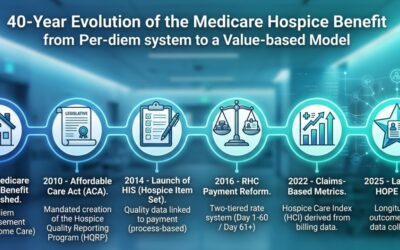
Understanding HQRP: The History of Hospice Quality
Hospice care, since its inception, has been about compassionate care. However, the underlying mechanisms of how it is paid for and how hospice quality is evaluated have undergone a significant transformation. This shift is part of a broader healthcare movement towards...

How to Improve Your Hospice Revenue Cycle: 7 Key Questions
Our previous installments, Strategic Hospice Revenue Cycle Management and Hospice Billing: How to Build a Clean-Claim Process, established that a healthy revenue cycle is the engine that allows an agency to maintain stability and focus on its clinical mission....

Hospice Billing: How to Build a Clean-Claim Process
In our first installment on Revenue Cycle Management (RCM) - Silent Killers of Hospice Cash Flow (and How to Fix Them) - we discussed why consistent working capital is the foundation of an agency's operational stability. It impacts staffing levels, vendor...

Silent Killers of Hospice Cash Flow (and How to Fix Them)
No hospice leader enters this field because they love claims and remittances. Their focus is not hospice cash flow optimization. Hospice leadership's goal is to ensure a dignified end-of-life journey for patients and families. They work to build an organization that...

Why Hospice Care is Turning to Non-Traditional Technology
Hospice has always been rooted in human presence: symptom relief, careful listening, emotional support, and the work of helping patients and families live meaningfully in the time that remains. That should not change. But if hospice is truly about quality of life,...

Analyzing the ‘Quiet Workforce’: New Insights into U.S. Family Caregiving
Many conversations about healthcare focus on hospitals, physicians, or emerging technologies. However, a significant portion of care in the United States occurs in a different setting: the home. Data from a recent Pew Research Center survey highlights the scale of...

How to Master the Hospice CBR for Better Compliance
Many hospice administrators are familiar with the hospice PEPPER report. A smaller number of hospice leaders, however, are familiar with its counterpart: the Comparative Billing Report (CBR) and eCBR, the electronic version of the Comparative Billing Report. While the...

Music, the Brain, and End-of-Life Care
A recent study published in PLOS ONE explores how music influences the way the brain processes, learns, and remembers information. The researchers found that listening to music - especially music that is familiar and predictable - can significantly affect attention,...

QAPI Documentation: How to Show Your Program is Active and Effective
Hospice leaders often understand that QAPI is required by CMS, but many do not know how to document the program in a way that proves it is genuinely active and effective. CMS surveyors want to see more than binders, charts, or paperwork. They are looking for...

How to Collect QAPI Data that Shows What Needs to Improve
In hospice, most organizations understand why Quality Assessment and Performance Improvement (QAPI) is required. What many do not understand is how to collect data in a way that reveals patterns, risks, and opportunities for improvement. QAPI data collection does not...