
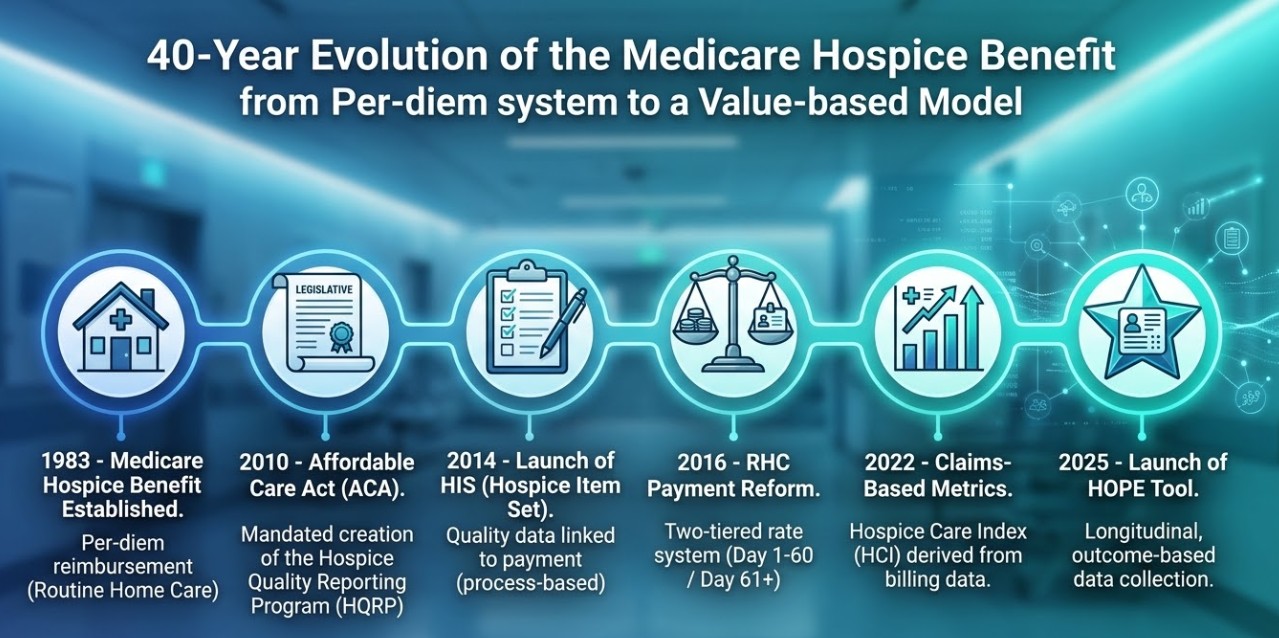
Hospice care, since its inception, has been about compassionate care. However, the underlying mechanisms of how it is paid for and how hospice quality is evaluated have undergone a significant transformation. This shift is part of a broader healthcare movement towards value-based care, moving away from simple fee-for-service models. For hospice, this journey can be understood through key eras and events.
1. The Foundation: 1983–2010
The concept of hospice care solidified with the establishment of the Medicare Hospice Benefit in 1983. This landmark legislation provided a structured way for Medicare beneficiaries to access comprehensive end-of-life care. Originally designed with a primary focus on cancer patients and shorter lengths of stay, it reflected the understanding of terminal care at the time. The reimbursement structure was a per-diem (per day) payment. This model, while straightforward, did not initially distinguish between different levels of care intensity.
The Medicare Hospice Benefit was established in 1983 under the Tax Equity and Fiscal Responsibility Act (TEFRA). For nearly three decades, the payment model was simple: a flat per-diem rate for four levels of care. It was designed for a different era – primarily for cancer patients with short, predictable lengths of stay. During this “Static Era,” CMS had financial data on what they paid, but almost no clinical data on what was actually happening in the home.
2. The Turn Toward Accountability: 2010–2014
As hospice use grew and patient demographics evolved, questions arose about varying practices and quality across providers. This ushered in an era focused on accountability and data collection. The Affordable Care Act (ACA) of 2010 changed the legal landscape. It mandated the creation of the Hospice Quality Reporting Program (HQRP). This marked a fundamental shift, transforming quality reporting from a voluntary endeavor into a mandated requirement for all hospice agencies.
A pivotal moment in this data-driven approach was the 2014 introduction of the Hospice Item Set (HIS). For the first time, agencies were required to submit standardized data on specific quality processes. This also tied hospice quality to payment. Failure to report HIS data resulted in a 2% (now 4%) reduction in the annual payment update.
However, HIS was a “process-based” tool. It measured if a hospice performed an action (like asking about pain), not whether the patient actually improved. Thus, while HIS was a vital step forward, its process-oriented nature was essentially retrospective. It confirmed whether specific admission and discharge procedures were documented, not necessarily if the patient’s well-being improved as a result.
3. Rebalancing the Payment Model: 2016
Parallel to the quality reporting initiatives, CMS implemented structural changes to the hospice payment system itself. In 2016, a significant change was introduced for Routine Home Care (RHC) payments. CMS realized the flat per-diem rate for Routine Home Care (RHC) didn’t match the reality of care delivery. This wasn’t about reducing payments, but about acknowledging the higher intensity of services typically required during the initial 60 days and the final days of a patient’s life.
CMS implemented RHC Payment Reform, creating two separate RHC rates: a higher rate for days 1–60 and a lower rate for days 61+. This was a structural signal that CMS was closely analyzing length-of-stay data and visit intensity. The different per-diem rates were were intended to incentivize a better alignment of payments with actual resource utilization.
Another key milestone was the creation of claims-based metrics. Recognizing the treasure trove of data within existing claims submissions, CMS developed indicators such as those within the Hospice Care Index (HCI). This approach utilized claims data to look for patterns related to care quality, such as the frequency of visits in the last days of life. This represents a clever use of existing data to derive quality insights, moving beyond self-reported assessments.
4. The Era of “Invisible” Metrics: 2022–Present
While agencies were focused on their clinical notes, CMS began using the bills themselves to measure quality. In 2022, they introduced the Hospice Care Index (HCI), a claims-based measure consisting of 10 indicators.
Unlike HIS, which clinicians fill out, the HCI is calculated entirely from existing claims data. This allows Medicare to identify patterns – like “live discharges” or “visits in the last days of life” – without requiring new forms, moving the industry closer to a Value-Based Purchasing mindset.
5. The Failed “Carve-In” and the Path to HOPE: 2021–2025
CMS also engaged in direct testing of value-based models through various pilots and demonstrations. One prominent example was the hospice component of the Value-Based Insurance Design (VBID) Model, often called the “hospice carve-in.” Launched in 2021, Value-Based Insurance Design (VBID) allowed Medicare Advantage plans to manage hospice benefits.
The goals of the VBID hospice carve-in were to assess if integrating hospice within a Medicare Advantage plan could improve care coordination, enhance quality, and reduce spending by preventing unnecessary hospitalizations. This initiative ran until 2024. The insights gained from this experiment, particularly regarding the need for robust quality measures and care coordination, continue to influence the overall direction of hospice payment and quality strategy. The experiment officially ended in December 2024, largely because CMS lacked a standardized, real-time clinical assessment tool to measure outcomes across different plans.
This brings us to the present. The Hospice Outcomes and Patient Evaluation (HOPE) tool, effective October 1, 2025, is the direct answer to this 40-year journey. CMS has finally reached a point where they are no longer satisfied with process checkboxes; they are building the infrastructure to pay for the actual impact of care.
The Path Forward and Why This Matters
The cumulative experiences from these various efforts – the process metrics of HIS, the structural changes in RHC payments, the deployment of claims-based metrics, and the practical learnings from models like VBID – all pointed to a persistent need. The industry required a standardized, patient-centric way to measure actual patient outcomes rather than just processes. This recognized need for more meaningful, outcome-focused data is a direct driver behind the development of the Hospice Outcomes and Patient Evaluation (HOPE) tool, that replaced HIS in late 2025. HOPE aims to capture data longitudinally during a patient’s stay, focusing on symptom impact and goal-setting – providing the rich data environment necessary to genuinely advance value-based care in hospice.
This historical overview illustrates that the shift towards value-based care in hospice is not a recent or sudden development. It has been a steady, deliberate evolution building upon the foundation laid in 1983, constantly striving for a more refined, data-driven system that ultimately ensures high-quality care is both provided and effectively measured. Every regulation, from the ACA to the HOPE tool, has been a stepping stone toward a system that rewards agencies for clinical outcomes rather than just census volume.


0 Comments