by editor | Dec 25, 2025 | Blog, Care Keys - Nurses, Clinical Compliance, Keys to Compassionate Care, Patient Care
Virtual nursing is rapidly gaining traction across healthcare, driven by workforce shortages and evolving expectations for care delivery. A recent JAMA Network Open article analyzing hospital-based virtual nursing offers important insights that extend well beyond acute care walls. While that research focuses on inpatient settings, the lessons it offers can help us imagine what virtual nursing could mean in a hospice at home environment.
What Hospital Research Tells Us
The JAMA Network Open article surveyed bedside nurses in hospitals using virtual nursing and found a complex picture. Virtual nurses in these settings were most frequently engaged in observation, patient education, and administrative tasks.
However, more than half of bedside nurses reported no significant reduction in workload. A small number of nurses even experienced increased workload. Perceptions of quality improvement were similarly mixed; many nurses saw little or no change, and some felt quality slightly declined. Nurses’ qualitative comments highlighted both the promise of virtual support as “an extra set of eyes” and real concerns about duplication of effort, delays, and patient skepticism when virtual roles were not well-integrated into care teams. Importantly, the article concluded that virtual nursing is most effective when it augments rather than replaces bedside care. Another important factor is whether workflows and roles are intentionally designed.
Additional research on virtual nursing in acute care echoes these points. Noted benefits are staff efficiency and patient safety when virtual roles are structured and supported. However, challenges in workflow integration are also highlighted. These findings provide a useful springboard for thinking about how virtual nursing might be adapted for hospice at home.
Reimagining Virtual Nurses for Hospice at Home
Hospice at home differs fundamentally from hospital settings. Instead of continuous bedside presence, visits from hospice clinicians occur intermittently. In the hours between visits, family caregivers become essential members of the care team. They are required to make critical judgments about symptom management and comfort. Care goals emphasize dignity, peace, and continuity – the sacred tasks of easing suffering as life concludes.
In this context, virtual nursing should not be a carbon copy of hospital-based programs. Instead of managing beds and admissions, virtual hospice nurses could focus on strengthening continuity between in-person visits, offering clinical guidance, reinforcing education, and supporting caregivers at moments of stress or uncertainty.
For hospice clinical staff, virtual nursing presents an opportunity to shift from task-oriented work toward a role that prioritizes coaching, coordination, and rapid response. Virtual nurses could reinforce teaching on comfort medications, conduct structured symptom assessments, and follow up after in-person visits to clarify care plans. If done well, this shift could free field nurses’ time for the deeply relational work that defines hospice care: nuanced assessment, physical comfort measures, and presence. However, the hospital experience warns us that lack of clear role boundaries and poor integration can lead to duplication and frustration. Successful hospice implementation requires clear documentation workflows and escalation pathways that allow virtual nurses to spur timely in-person action when needed.
What It Could Mean for Patients
For patients receiving hospice support at home, virtual nursing has the potential to reduce suffering and anxiety between visits. Distressing questions like “Is this normal?” or “Should I take another dose?” could be answered more promptly. Research on telehealth in palliative care suggests that such remote support can improve symptom control and caregiver confidence, and may help patients remain at home longer.
At the same time, patients vary in how they engage with virtual care. Some will welcome frequent check-ins and reassurance. Others, particularly those who value privacy, may prefer audio-only communication or asynchronous messaging. Offering choice in modality respects autonomy and preserves dignity.
Supporting Caregivers Where It Matters Most
Family caregivers are often in the line of fire between scheduled visits. They administer medications, monitor symptoms, and make complex decisions often without formal training. Virtual nurses could function as real-time coaches. They can reinforce care techniques, help anticipate symptom trajectories, and suggest coping strategies. Evidence from hospice and palliative settings shows that telehealth support can reduce caregiver isolation and enhance confidence, particularly when internet connectivity and tech support are reliable.
Caregiver experiences during telehospice interactions also highlight common barriers: confusion over virtual policies and concerns about equity of access. These underscore the need for telehealth models that are accessible, simple, and optional, with phone contact treated as a fully legitimate form of virtual support.
Ethical and Practical Considerations
Telehealth in home-based palliative care raises important ethical questions. Research in this area emphasizes the need to balance autonomy, beneficence, nonmaleficence, and justice when integrating digital tools into care at the end of life. Ensuring that technology enhances rather than infringes on these core principles is critical when designing virtual nurse roles.
It’s also important to recognize broader telehealth challenges such as privacy, regulatory barriers, and reimbursement complexities, which affect both providers and patients. Reviews note that although telehealth can improve access and satisfaction, its widespread adoption has been slowed by legal, payment, and technology hurdles.
The Future of Hospice Virtual Nursing
With thoughtful design, virtual nursing could become one of the most caregiver-centered innovations in hospice care. It holds the promise of bridging the hours between visits, supporting caregivers in critical moments, and making expert guidance more accessible. This can all be made possible while simultaneously honoring the relational ethos of hospice. Future efforts should prioritize workflow clarity, patient autonomy, caregiver support, equity of access, and continuous evaluation to ensure virtual nursing enhances the sanctuary of care at life’s end.
Further Reading
For readers who want to explore the broader evidence and context around virtual care, here are links to additional resources:

by editor | Nov 25, 2025 | Blog, Care Keys - Nurses, Care Keys - Social Workers, Clinical Compliance, Compliance and Regulatory - Directors, Keys to Compassionate Care, Patient Care, Resources and Readings
End-of-life decisions are some of the hardest moments any family, clinician, or hospice team will ever face. Even when a patient has had candid conversations with loved ones, the reality of decline can feel different than anything imagined. When there is no advance directive or clear documentation of the patient’s wishes, those decisions become even more complex. Families may disagree, memories of past conversations may not align, and the clinical team is left trying to balance what is medically appropriate with what might honor the patient’s values. The result is often a mix of uncertainty, guilt, and emotional strain for everyone at the bedside.
This is the space where new data tools and artificial intelligence are starting to appear. Some models claim they can estimate what treatments a patient might choose at the end of life based on patterns in large data sets. Others aim to predict who is at higher risk of dying within a certain time frame, nudging clinicians to start goals-of-care conversations sooner or to consider hospice or palliative care earlier. For hospice and healthcare teams already stretched thin, it can be tempting to see these tools as a way to “solve” the hardest part of care: figuring out what to do when nothing is simple and time is short.
But there is a crucial distinction to hold onto: data and AI can support decision-making; they should not be the decision-maker. An algorithm might highlight that a patient shares characteristics with others who tended to decline aggressive interventions. It might flag that prognosis is shorter than it appears at first glance.
Yet it cannot sit with the family in their grief, it cannot understand a patient’s faith in the way a chaplain can, and it cannot weigh the quiet promises made at a kitchen table months or years before the illness progressed.
At best, AI can offer additional information, patterns, or prompts that help humans ask better questions. It cannot take away the responsibility – or the privilege – of truly listening to what matters most to the patient.
Ethical Challenges
This is where the ethical challenges begin to surface. If an AI model suggests that a patient “would not want” a particular treatment, how much weight should that suggestion carry, especially when there is no formal advance directive? If a clinician disagrees with the model’s output based on what they have heard from the patient or family, whose judgment should guide the plan of care? And if families hear that “the data says” their loved one would choose a certain path, will they feel free to disagree? Or, will they feel pressured by the perceived neutrality and authority of the algorithm? The more powerful and precise these tools appear, the more they risk subtly shifting who feels entitled to make the final call.
For clinical staff, the questions become deeply personal and practical. How will you integrate AI-generated risk scores or preference predictions into your bedside conversations without letting them overshadow your clinical intuition and your understanding of the patient’s story? When a model’s suggestion conflicts with what a patient or family is clearly expressing now, what will guide your next step? How might your moral distress change if a decision later comes into question and someone asks, “Why didn’t you follow what the algorithm recommended?” or, conversely, “Why did you rely on it so heavily?”
For administrators, AI at the end of life raises strategic and cultural questions. If your organization adopts tools that predict mortality or likely treatment preferences, how will that change workflows, staffing, and expectations around hospice and palliative care referrals? Will there be pressure – subtle or explicit – to align care patterns with what the data suggests, especially if payers or partner organizations see AI as a way to manage cost and utilization? How will you communicate to your teams, and to your community, that these tools are meant to inform compassionate care rather than to standardize deeply human decisions?
And for compliance and ethics leaders, AI adds new layers of risk and responsibility. If an AI recommendation influences an end-of-life decision, how should that be documented? What happens if patterns emerge showing that the tool performs differently across racial, cultural, or language groups? Who owns the responsibility to investigate and respond? Is there a point at which the use of AI in end-of-life decision-making should trigger explicit disclosure or consent from patients and families? And if your organization chooses not to use these tools while others do, could that one day be seen as a gap in standard of care – or as a principled stance on preserving human judgment?
End-of-Life Decisions Live in a Crowded Space
None of these questions have easy answers, and perhaps they shouldn’t. End-of-life decisions have always lived in a space where medicine, ethics, family, and faith meet. AI does not change that; it just adds a new voice into an already crowded room. The challenge for hospice and healthcare teams may not be whether to use these tools at all, but how to use them in a way that keeps the center of gravity firmly with the patient and those who know them best.
As AI continues to move closer to the bedside, each organization – and each role within it – will have to keep asking:
- What do we want AI to do in end-of-life care, and what do we want to reserve for humans alone?
- How will we notice if the technology meant to support us is quietly shaping decisions more than we realize?
- And in the moments when nothing is clear and there is no advance directive to guide us, whose voice should carry the most weight: the algorithm’s, the family’s, the clinician’s, or the patient’s story as we have come to know it?
Hospice and palliative care have always been about making room for the hard questions. AI doesn’t take those questions away – it may simply give us new ones to live with.
Reading Material
by editor | Jan 23, 2025 | Care Keys - Aides, Care Keys - Chaplains, Care Keys - Nurses, Care Keys - Social Workers, Career Advancement, Clinical Compliance, Patient Care, Rules and Regulations - Chaplains
What is mandatory reporting?
Hospice clinicians advocate for their patients and their patients’ families. As a clinician, one of the most important ways that you can advocate for their patient is by engaging in mandatory reporting when you observe or suspect that your patient is being neglected or abused.
What is a mandatory reporter?
A mandatory reporter has an individual duty to report known or suspected abuse or neglect relating to children, dependent adults, or elders. These include:
- A child is anyone who is under 18 years old
- A dependent adult is anyone between 18 and 64 years of age who has physical or mental limitations that restrict their abilities to carry out normal activities or protection of their rights
- An elder is anyone 65 years of age or older
A reporter should report good faith beliefs or reasonable suspicions of abuse or neglect. The report will be confidential, and the identity of the reporter will be hidden from the public.
Who are mandated reporters?
State-specific laws specify several professions of mandatory reporters. These include professions such as:
- Social workers
- Teachers
- Healthcare workers
- Law enforcement
- Childcare providers
- Medical professionals
- Clergy
- Mental health professionals
The list of professions of mandatory reporters varies by state.
What is abuse?
Although we often think of abuse as physical abuse, remember that abuse can come in all different forms. For example, forms of abuse include:
- Physical abuse
- Mental anguish
- Financial abuse
- Sexual abuse
- Emotional abuse
Protect your patients by looking out for all of these different forms of abuse. No one deserves to be subject to any form of abuse.
How can you best protect your patient?
To best protect your patients, constantly be aware and on the lookout for any types of abuse or neglect. Hospice patients are vulnerable since they are often physically frail, dependent on others around them for support and care, and unable to advocate for themselves. As a healthcare worker, you need to advocate for your patient in the case of suspected neglect or abuse.
Continually assess the patient for any signs of abuse or neglect. Look out for any unusual behaviors. Follow any of your agency’s protocols in documenting any observations and conversations. If you identify concerns, share these concerns with the appropriate individual in your agency.
How do you report?
If your agency cannot provide you with clear guidance about how to report the suspected abuse or negligence, each state has websites that can provide you with that guidance. Each state has specific requirements on what you must report, required timing of reporting, and the like.
In addition, most states have reporting hotlines. Remember to be detailed and accurate when you file the report and to provide all the required information.
Why is it important for you to report?
Sometimes, you “may not want to bother” to report suspected abuse or you may feel “it is not your business to get involved”. However, here are two key considerations:
- As a healthcare worker and medical professional, you are a mandated reporter and as such, by law, you have a duty to report known or suspected abuse or neglect
- As a patient advocate and healthcare professional, you have an ethical duty to report instances of known or suspected abuse or neglect
Identifying abuse or neglect as early as possible is critical for the physical and mental health of the abused or neglected individual. Your actions can have profound positive consequences on your patient’s life. Remember: if you see something say something!
Where can you find out more?

by editor | Dec 10, 2024 | Clinical Compliance, Compliance and Regulatory - Directors, Human Resources, Keys to Compassionate Care, Regulatory Compliance
When an employee brings forward a compliance concern, they’re engaging in what the law defines as protected activity. This might involve reporting a potential violation of hospice regulations, concerns about Medicare fraud, or even raising issues about unsafe working conditions. These are rights guaranteed under various laws, like the False Claims Act, OSHA protections, and Title VII of the Civil Rights Act, which protect employees who speak up.
In responding to employee concerns, there is a fine line between addressing workplace concerns and crossing into retaliation territory. Retaliation isn’t always a blatant act of revenge. Sometimes, it’s more subtle, even subconscious. Sometimes management at the hospice agency may feel frustrated or betrayed by an employee’s complaint and – without realizing it – allow those feelings to influence their decisions. Maybe the employee was already struggling with performance, or maybe there were pre-existing tensions on the team. But when an adverse action—like firing, demotion, or cutting hours—happens shortly after a complaint, it’s easy for that decision to be seen as retaliatory, even if it wasn’t intended that way.
What is Retaliation?
To clarify what retaliation means, it’s any adverse action taken against an employee because they engaged in protected activity. Timing is a major red flag here. If an employee files a compliance report and is terminated shortly after, it raises questions. Even if you feel justified in your decision, the timing alone can look suspect to a court, regulatory agency, or even the employee’s peers.
What are the Consequences of Retaliation
And the consequences for retaliation? They’re not just legal—they’re also reputational. If a claim is brought against an agency, the agency could face:
- Reinstatement of the employee to their position, even if you’ve moved on.
- Back pay, damages, and legal fees, which can quickly add up.
- Regulatory scrutiny, which might open the door to deeper investigations into the agency’s practices.
- And, perhaps most damaging, the perception that we don’t care about compliance or employee rights. That’s not a message we can afford to send.
From the employee’s perspective, they have a number of options if they feel they’ve been retaliated against. They might file a complaint with OSHA, EEOC, or state regulators. They could seek legal action for wrongful termination or take their concerns to external auditors or even the media. Once that door is opened, the hospice agency loses control of the narrative.
How Can You Avoid Retaliatory Behavior?
So, what can you do to avoid even the appearance of retaliation? Here’s are some suggestions:
- Document everything: If there are performance concerns or other issues unrelated to the complaint, make sure there’s a clear, consistent record. This documentation can be your best defense.
- Separate decision-making: If you’re in the middle of handling a compliance complaint, let someone outside the situation—like your compliance officer or HR—review any proposed actions against the employee.
- Follow established protocols: Deviating from your normal policies, especially when dealing with someone who has raised a complaint, can make it look like you are targeting them.
- Train your leaders: Everyone in management needs to understand what retaliation looks like and how to avoid it.
Leadership sometimes expresses concerns about employees “stirring up trouble” or raising issues for self-protection. But the law doesn’t distinguish between “valid” and “troublesome” complaints. Protected activity is protected activity, full stop.
Take a step back. If you’re ever considering taking action against an employee who has engaged in protected activity, discuss it first with your HR or compliance team. Together, you can ensure the decision is based on legitimate, well-documented reasons and not influenced—even unconsciously—by the complaint itself.
At the end of the day, your goal is to serve patients and families with integrity and compassion. That means creating a culture where employees feel safe to speak up about compliance issues without fear of retaliation. Protecting that culture isn’t just about avoiding lawsuits—it’s about doing what’s right for your team, your agency, and the people you care for.

by editor | Aug 23, 2024 | Care Keys - Aides, Care Keys - Nurses, Clinical Compliance
As a hospice home health aide (HHA), you have an important job in taking care of patients. Part of your job is helping with medications, but it’s really important to know what you can and can’t do. The rules might change depending on the state you work in, because each state has its own guidelines. Knowing these rules helps you give the best care to your patients while staying safe and following the law.
Why Medications Are Important
Medications help patients feel better when taken the right way. Here are some things hospice aides should do:
- Remind Patients: Make sure patients take their medicine on time.
- Watch for Changes: Pay attention to how patients feel after taking their medicine.
- Report to a Nurse: If a patient feels sick or different after taking medicine, tell a nurse right away.
Doing these things helps keep the patient safe and healthy. Let’s look at these ideas more closely.
What You Need to Know About Medications
- Medication Adherence: It’s really important that patients take their medicine exactly as the doctor says. If they miss doses or take it wrong, their symptoms might get worse. You can help by reminding patients to take their medicine and making sure they take the right amount at the right time. But remember, what you can do to help might be limited by state rules.
- Recognizing Side Effects: You should know about the common side effects of the medicines your patients take. You don’t need to know everything, but be aware of signs like dizziness, sleepiness, or changes in behavior. If you notice something unusual, tell the nurse right away. State guidelines often say it’s your job to watch for and report these things.
- Understanding Medication Schedules: Some medicines need to be taken at certain times, with food, or on an empty stomach. You should know these basic rules so you can help patients stick to their schedule. But remember, you can’t change the schedule or the medicine—only a doctor or nurse can do that.
- Communication with the Healthcare Team: It’s really important to tell the healthcare team about any problems with taking medications, side effects, or new over-the-counter (OTC) medicines the patient might be using. State rules usually say you must keep clear and accurate notes about your observations.
What Can a Hospice Aide Do with Medications?
- Remind Patients: In most states, you can remind patients to take their medicine. This is really important, especially for patients who might forget or have a strict schedule. But remember, reminding isn’t the same as giving the medicine. Usually, you can’t put the medicine in the patient’s mouth or give them a shot unless you have special training and the state allows it.
- Help with Medication Setup: In some states, you might help patients by setting up a pillbox or organizing their medicine, but only under a nurse’s supervision. This helps make sure the patient takes the right dose at the right time. Remember, the patient or a licensed professional must give the medicine.
- Observe and Report: You spend a lot of time with the patient, so you might be the first to notice changes in how they feel. You should know which medicines the patient is taking so you can spot any side effects, missed doses, or other problems. Always report these to the nurse and write down what you observed, if your state allows it. Just remember, only write down what you see—don’t make any medical guesses.
What Can’t a Hospice Aide Do with Medications?
- You can’t give the medicine directly to the patient, like putting a pill in their mouth
- You can’t give shots or injections.
Your job is to help and remind patients about their medicine, not to give it directly.
Safety First!
- Follow the Rules: Every state has different rules about what you can do with medications. Some states let you help a little more, like setting up pillboxes, while others have stricter rules. Following these rules keeps everyone safe.
- Ask if You’re Not Sure: If you’re not sure about something with medications, always ask a nurse or follow your agency’s guidelines.
Where Can You Find Out More
by editor | Aug 11, 2024 | Care Keys - Aides, Clinical Compliance
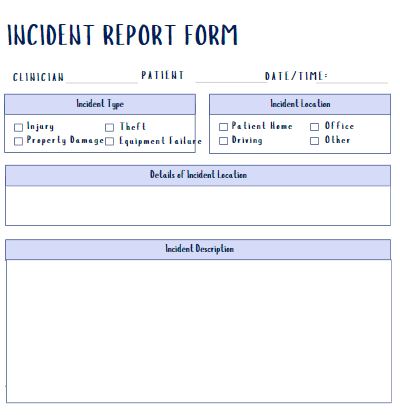
An incident report is a special kind of report that you write when something unusual or unexpected happens during your visit with a patient. This could be anything that isn’t part of the normal care routine.
When to Write an Incident Report
An incident report is needed if:
- The Patient Falls: If the patient slips, trips, or falls, even if they don’t seem hurt.
- An Injury Happens: If the patient, a family member, or even you get hurt in any way.
- A Medication or Care Error: If the wrong medicine is given, or if medicine is given at the wrong time or if there a different error in patient care.
- Behavior Changes: If the patient suddenly becomes very confused, angry, or upset.
- Safety Concerns: If something dangerous happens or almost happens, like if a patient tries to leave the house when they shouldn’t or if you feel uncomfortable or unsafe.
- Property Damage: If anything breaks or is damaged during the visit.
- Blood or Fluid Exposure: If you are exposed to blood or body fluids during the visit.
How to Write an Incident Report
- Write It Right Away: Write the report as soon as the incident happens. This way, the details are fresh in your mind.
- Stick to the Facts: Describe exactly what happened. Don’t guess or add your opinions. Just describe what you saw and heard.
- Be Specific: Include details like the time, place, and exactly what happened. If someone said something important, use their exact words.
- Report Injuries: If anyone was hurt, describe the injury and what was done to help.
- Include Witnesses: If someone else saw what happened, include their name and what they saw.
- Stay Calm: Use clear and simple words. Don’t blame anyone in the report, just describe what happened.
- Tell Your Supervisor: Always report the incident to your supervisor as soon as possible.
Why Incident Reports Matter
- Safety: Incident reports help keep patients and caregivers safe by making sure everyone knows about any problems or risk.
- Improvement: These reports help the care team learn from mistakes and prevent them from happening again.
- Legal Protection: Documenting incidents protects you and the agency by showing that you reported what happened.