by editor | Oct 18, 2022 | Billing, Billing - General, Compliance and Regulatory - Directors, Hospice 101 - Aides, Hospice 101 - Chaplain, Hospice 101 - Office Team, Hospice 101 - Social Workers, Rules and Regulations - Chaplains, Rules and Regulations - Nurses, Rules and Regulations - Social Workers
To receive hospice services under the Medicare benefit, a patient or his authorized representative must elect hospice care.
If the patient or authorized representative elects to receive hospice care, the patient must file an election statement with a specific hospice agency. The election statement serves to indicate that the patient is choosing hospice care.
The election statement and the election statement addendum are conditions for payment.
What is the structure of a hospice election form?
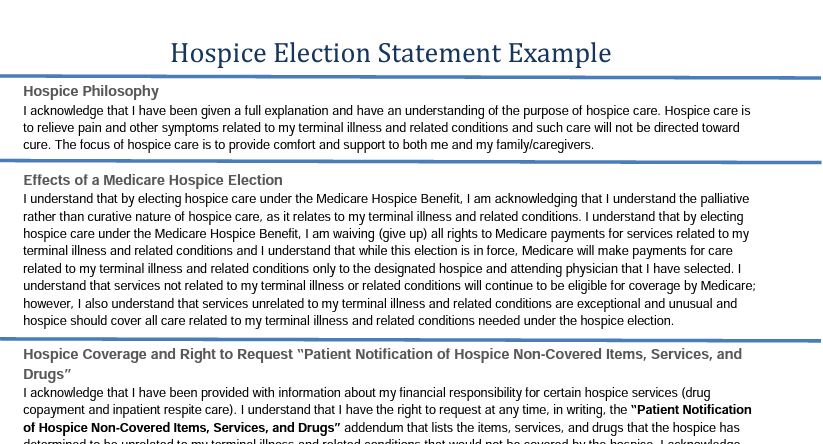
Every hospice agency can design and create their own hospice election statement form although Medicare has published a model form that can be used by hospice agencies Model Hospice Election Statement. The election statement must include all of the following elements:
- Name of hospice agency that will be providing the services
- Acknowledge that nature of hospice services have been explained to the patient including, in particular, the palliative rather than curative nature of care
- Acknowledge patient understands that by electing hospice care, some Medicare services are waived
- For hospice elections beginning on or after October 1, 2020, a statement that although it would be rare, there could be some necessary items, drugs, or services that may not be covered by hospice because these items are deemed to be unrelated to the terminal illness or related conditions
- The effective date of the election. This may be the first day of hospice care of a later day. But it cannot be a date that precedes the date that the election statement was signed by the patient or their authorized representative.
- The individual who is serving as the patient’s attending physician, if any.
- Acknowledgement that the identified attending physician was the choice of the patient or authorized representative
- Signature of patient or authorized representative
There are some additional requirements for the election statements for elections beginning dated October 1, 2020 or later. These election statements must also include :
- Information on patient cost sharing for hospice services
- Notification of the patient or authorized representative right to receive an addendum to the election statement. The addendum is only required to be furnished to beneficiaries, their authorized representatives, non-hospice providers, or Medicare contractors who request this information. This addendum includes a list and rationale for the items, drugs, or services that are not covered by hospice services because the hospice has deemed these to be unrelated to the terminal illness and related conditions.
- Information on the Beneficiary and Family Centered Care Quality Improvement Organization (Beneficiary and Family Centered Care (BFCC) ), including that immediate advocacy is available through this organization if the patient disagrees with the hospice’s determination regarding non-covered services
Right to Request Patient Notification of Non-Covered Items, Services, And Drugs
At any time, a patient may request, in writing, the Patient Notification of Hospice Non-Covered Items, Services, and Drugs. addendum to the election statement.
The hospice agency must provide the notification within five days, if this request is made on the start of care date.
If the request is made during the course of hospice care, the hospice agency must provide the requested notification within 72 hours.
If the patient (or authorized representative) requests the addendum at the start of care but dies with five days, the hospice is deemed to have met its requirement and is not required to provide the addendum.
When would a hospice update the addendum?
The addendum lists the patient’s diagnoses and conditions that are present upon hospice admission and the items, services, and drugs that are not covered by the hospice because they are deemed to be unrelated to the terminal illness and related conditions.
During the course of hospice care, the addendum may require update, for example, if the patient’s plan of care is updated.
Changes to the addendum will need to be signed by the patient or his authorized representative and stored in the patient’s medical record with the hospice agency.
Where can you find more information on the election statement
by editor | Sep 29, 2022 | Billing, Billing - General, Compliance and Regulatory - Directors, Financials, Rules and Regulations - Office Team
What is Medicare credit balance?
A Medicare credit balance represents a Medicare overpayment to a provider due to patient billing error or claims processing error that must be refunded to Medicare. The report is referred to as a Credit Balance Report because when a provider receives excess payment for a claim that was submitted, this is typically reflected in the provider’s accounting records (i.e., in the patient account receivable) as a “credit.”
What instances may give rise to a credit balance?
Different situations may give rise to a Medicare overpayment. For example:
- Paid twice by Medicare or may be paid by Medicare and by another insurer for the same service
- Incorrect calculation of patient deductible or patient coinsurance amount
- Paid for non-covered services
- Billed at incorrect daily rate
Which hospice agencies must file a Credit Balance Report?
If a hospice provider has more than one provider number, a separate report must be submitted for each provider number. Providers who have a low utilization (i.e., determined by the intermediary that they should file a low utilization Medicare cost report) or who file less than 25 Medicare claims per year are not required to file a Medicare Credit Balance Report.
What does a credit Balance Report Consist of?
The Credit Balance Report consists of two pages. The first page is a Detail Page, where the hospice provider enters information about each credit balance, on a claim by claim basis. Once a claim has been reported on one Credit Balance Report it should not be reported again on a subsequent Credit Balance report. The second page is a Certification Page. All providers must complete the Certification Page. The Detail Page is only required if the provider has credit balances to report.
The Detail Page
On this page, the provider must include detailed information about each Medicare claim with a credit balance, explanation why the credit balance arose, and indicate whether the credit balance is being repaid with the filing of the report.
The Certification Page
The second page of the Credit Balance Report is a certification page. Facilities that do not have any credit balances in a quarter are only required to submit the signed certification page. There are key areas of this page.
- The first area serves as a reminder that there is a requirement to file a Credit Balance Report and failure to file this report will result in suspension of Medicare payments. Further, any misrepresentations may lead to fines and further penalties
- The second area requires an officer or administrator of the hospice agency to sign a certification that that Credit Balance Report is true and accurate
- The third area requires a selection from one of three choices: (i) provider qualifies as Low Utilization Provider (ii) Detail Page included with Report (iii) no credit balances to report
When is the report due?
A hospice provider must assess any Medicare credit balances on a quarterly basis and must report any identified Medicare credit balances within 30 days of the end of each calendar quarter. The Medicare Credit Balance Report due dates are as follows:
| Quarter Ending |
Due Date |
| March 31 |
April 30 |
| June 30 |
July 30 |
| September 30 |
October 30 |
| December 31 |
January 30 |
What happens if a provider fails to submit a Credit Balance Report?
Failure to submit a Credit Balance Report by the 15th calendar day after the report due date will result in a Suspension Warning letter. If the completed report is not received within 15 calendar days from issuance of the letter, Medicare payments to the provider are suspended under a completed letter is received, accepted, and processed.
Where can you find a Credit Balance Report form?
The Credit Balance Report that must be completed and submitted is Form CMS-838, which can be found here: Medicare Credit Balance Form (pdf)
by editor | Sep 20, 2022 | Billing, Billing - General, Compliance and Regulatory - Directors, Financials, Intake, Notice of Election, Rules and Regulations - Nurses, Rules and Regulations - Office Team
by editor | Sep 15, 2022 | Accounts Payable, Billing, Billing - General, Compliance and Regulatory - Directors, Documentation - Nurses, Hospice 101 - Aides, Hospice 101 - Chaplain, Hospice 101 - Nurses, Hospice 101 - Office Team, Hospice 101 - Social Workers, Human Resources, Intake, Medical Records, Metrics and KPIs, Office Setup, Payroll, Rules and Regulations - Chaplains, Rules and Regulations - Nurses, Rules and Regulations - Social Workers, Rules and Regulations - Volunteers
Are you confused by the Acronym Alphabet Soup?
Does the never ending list of acronyms used in the hospice and healthcare industry leave you confused?
Are you worried that you may confuse CMN with CMP?
To help sort out the confusion, we add here links to lists of acronyms:
Use these acronym listings to help clarify things when you inevitably are faced with acronym confusion!


by editor | Sep 12, 2022 | Billing, Billing - General, Compliance and Regulatory - Directors, Documentation - Nurses, Financials, Intake, Medical Records, Notice of Election
The Notice of Election (NOE) is more than a clinical administrative task; it is a critical financial trigger. In the hospice revenue cycle, the NOE serves as the formal notification to Medicare that an agency has assumed responsibility for a patient’s care. Failure to file this document within the mandatory window results in permanent, unrecoverable revenue loss.
The Standard for Timely Filing
Medicare regulations require that an NOE be filed within five calendar days after the beneficiary’s hospice admission date. For a filing to be considered legally “timely,” it must meet two specific criteria:
- Receipt Date: The NOE must be received by the Medicare contractor within five calendar days after the admission date.
- Processing Status: The NOE must successfully process and reach the final status/location P B9997.
The Cost of Non-Compliance
When an NOE is filed late, the financial consequences are immediate. Medicare will not reimburse the agency for the days of care provided from the date of admission until the date the NOE is finally submitted and accepted.
Consider this example of a late filing:
- Admission Date: May 1st
- NOE Receipt Date: May 10th
- The Result: The agency is responsible for the cost of care from May 1st through May 9th. These nine days are considered “non-covered” and represent a 100% loss of revenue for that period.
The “RTP” Trap: Resubmissions and Timeliness
One of the most common drivers of revenue loss is the Return to Provider (RTP) error. If an NOE is submitted within the five-day window but contains errors, it will be sent back for corrections.
It is critical to understand that the resubmission date becomes the new “receipt date” for timeliness purposes. Even if your initial attempt was on day two, if the corrected version isn’t accepted until day ten, the entire period remains non-covered. This is why “clean” initial submissions are just as important as “fast” submissions.
Operational Requirements for Late Filings
If an agency identifies that an NOE was filed untimely, the subsequent claim must be coded specifically to reflect the non-covered period. This is not optional; failure to code correctly can lead to claim rejections or audits.
- Occurrence Span Code (OSC) 77: This must be used on the claim to identify the specific dates that are non-covered due to the late NOE.
- Dual-Line Billing: The claim must be split into two distinct rows: one for the non-covered days (associated with OSC 77) and one for the covered days following the NOE acceptance.
Leadership Strategy: Moving to a 48-Hour Standard
To eliminate the risk of late filings, high-performing agencies do not aim for the five-day deadline. Instead, they implement an internal 48-hour submission rule.
By requiring NOEs to be filed within two days of admission, leadership creates a “buffer” to handle unexpected RTP errors or technical issues with the billing software. This proactive operating rhythm ensures that administrative delays never compromise the agency’s financial stability or the clinical team’s ability to focus on patient care.
by editor | Sep 12, 2022 | Billing, Billing - General, Compliance and Regulatory - Directors, Financials, Metrics and KPIs, Office Setup, Rules and Regulations - Nurses
A Medicare Administrative Contractor (MAC) is a private health care insurer that has been awarded a geographic jurisdiction to process Medicare Part A and Part B medical claims for Fee For Service (FFS) beneficiaries.
CMS relies on these contractors to serve as the primary operational contact between the Medicare FFS program and the health providers enrolled in the program.
MACs are multi-state regional contractors who are responsible for administering Part A and Part B claims.
What types of MACs are there?
There are two types of MACs: Part A/B MACs and DME MACs.
Hospice claims are administered by Part A/B MACs. Part A/B MACs process about 95% of all FFS claims.
There are 12 Part A/B MACs.
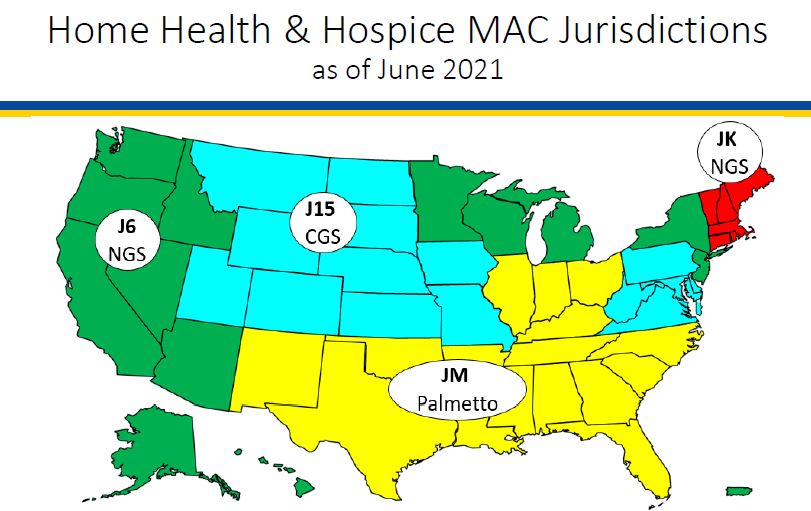
Four of the MACs specialize in processing claims for hospice and home health providers
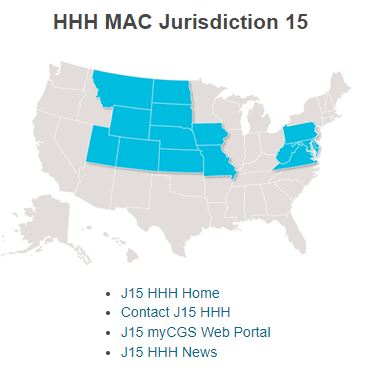
What geographic areas do each of the hospice and home health MACs cover?
The following map shows the geographic regions that each of the hospice MACs is responsible for administering.
What activities do MACs perform?
MACS perform a number of activities including:
-
Provider Enrollment
-
Claims processing, payment, and payment notices
-
Provider customer service (but not beneficiary customer service)
-
Audit provider cost reports
-
Respond to provider inquiries
-
Audit payments and review medical records
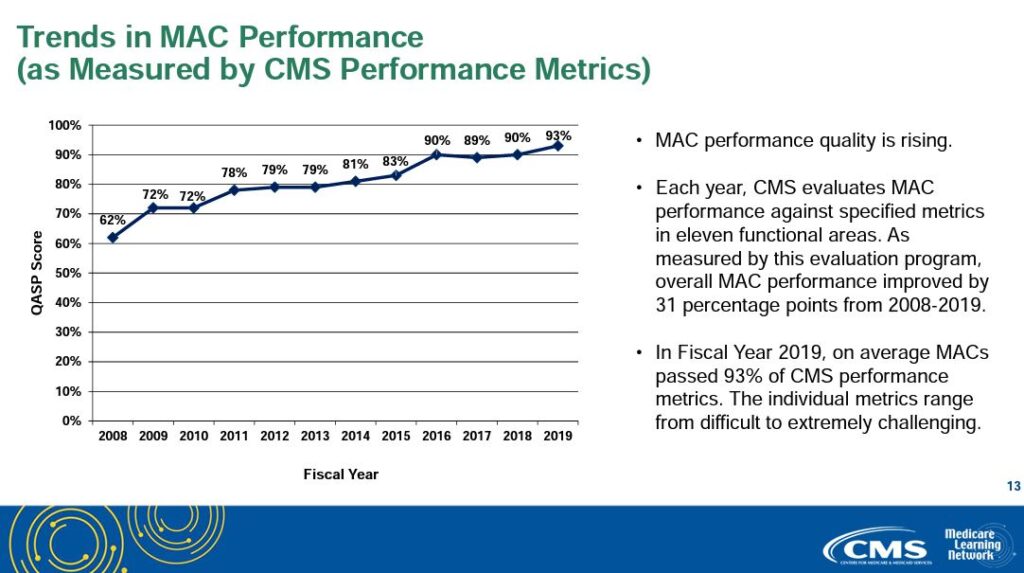
How are MACs measured and how well do they perform?
Each year, CMS evaluates MAC performance against specific metrics in eleven functional areas. MAC performance quality has been consistently improving since CMS began measuring MAC performance. Average MAC performance has increased from 62% to 93% since CMS began measuring MAC performance.
Print ‘n take hospice keys
- Seeking to contact your MAC? Here’s their contact information
Download
- A map of MAC regional jurisdictions
Download
Where can you find more information?
This PowerPoint from Medicare Learning Network provides more helpful information about MACs: MLN MAC PowerPoint