
by editor | Sep 8, 2022 | Billing, Billing - General, Compliance and Regulatory - Directors, Intake, Notice of Election, Rules and Regulations - Nurses
What is a Notice of Election?
When a Medicare beneficiary elects hospice services, the hospice must complete an election notice with the beneficiary and file a Notice of Election (NOE) with Medicare. A Notice of Election (NOE) is the formal mechanism used to notify Medicare that a beneficiary has elected the hospice benefit. While the concept is straightforward, the submission process requires high technical accuracy to meet the mandatory five-day filing window.
Submission Timing and the “Clean Claim” Requirement
Medicare requires that an NOE be submitted and processed before the agency files its first claim for that beneficiary. Since October 1, 2014, the standard has been strict: the NOE must be filed within five calendar days of the election date.
To satisfy this requirement, the submission must be “clean” – meaning, it is free of data entry errors. If an NOE contains errors, it is Returned to Provider (RTP). Once corrected and resubmitted, the NOE receives a new receipt date, which can push the filing outside the five-day window and result in non-covered days.
Three Methods for NOE Submission
Hospice providers currently have three avenues for submitting the NOE. Each carries different levels of administrative burden and risk of error.
1. Electronic Data Interchange (EDI) – Recommended
Effective January 1, 2018, Medicare allowed for NOE submission via EDI. This is the most efficient method for agencies seeking a predictable operating rhythm.
- The Benefit: Data is exported directly from the patient’s Electronic Medical Record (EMR), virtually eliminating manual keying errors.
- Operational Note: NOEs submitted via EDI should not be batched with standard claims; they must be processed as distinct transactions.
2. Direct Data Entry (DDE)
DDE involves manually entering the NOE into the Fiscal Intermediary Shared System (FISS).
- The Benefit: DDE provides real-time access to monitor claim status, check beneficiary eligibility, and correct errors.
- The Risk: Because this requires manual entry across multiple screens, it is highly susceptible to human error, which often leads to RTP status and potential filing delays.
3. Paper Submission (UB-04)
While technically permitted, submitting a physical UB-04 form via mail is the least efficient method.
- The Risk: This method is subject to mail delays and manual processing times at the Medicare Administrative Contractor (MAC), making it nearly impossible to guarantee compliance with the five-day window.
Ensuring Submission Accuracy
Regardless of the method chosen, the data requirements remain the same. Leadership should ensure that the billing team is utilizing verified “job aids” from their specific MAC (such as Palmetto GBA, CGS, or NGS) to ensure every data field – from the NPI to the admission date – is perfectly aligned with the election statement.
By prioritizing EDI submission, agencies can reduce their reliance on manual intervention and ensure that the “engine” of the revenue cycle remains stable and compliant.

by editor | Aug 4, 2022 | Billing, Billing - General, Compliance and Regulatory, Compliance and Regulatory - Directors, Documentation - Nurses, Financials, Intake, Patient Care, Rules and Regulations - Nurses, Rules and Regulations - Office Team
Prior to the third hospice benefit period, and prior to each subsequent benefit period, a hospice physician or nurse practitioner is required to have a face to face encounter with the hospice patient to recertify that the patient continues to be Medicare eligible for hospice benefits. The face to face encounter must occur within 30 calendar days prior to the start of the third benefit period and each subsequent benefit period.
The face to face encounter is necessary to recertify that the patient remains eligible for Medicare hospice benefits. If face to face encounters are not performed timely, the patient is is no longer hospice eligible. The hospice may continue to provide hospice services to the patient but may no longer continue to bill Medicare. Instead, the hospice would need to assume all financial responsibility for the patient until such time that the hospice is able to reestablish patient hospice eligibility. The patient may be readmitted to hospice once hospice eligibility criteria are once again met.
What if there are exceptional circumstances that cause the hospice to be unable to timely complete the face to face encounter?
What are exceptional circumstances?
If a patient is admitted and is in the third benefit period or later, the hospice agency may be unable to perform the face to face encounter prior to the start of the benefit period.
For example, if the patient is an emergency weekend admission and the nurse practitioner or hospice physician is unable to meet with the patient prior to hospice admission. The patient is only seen the following Monday.
Another exceptional circumstance may be where the CMS data system is unavailable and the hospice agency is unaware that the patient is in the third or later benefit period.
In these documented exceptional circumstances, the face to face encounter is considered timely if it is completed within two days after admission.
In addition, if the patient dies within two days of admission, the face to face encounter is considered complete.
Where can you get more information?
Details on Medicare Face to Face encounter requirements: Medicare F2F encounter requirements

by editor | Aug 4, 2022 | Billing, Billing - General, Compliance and Regulatory - Directors, Documentation - Nurses, Financials, Hospice 101 - Aides, Hospice 101 - Chaplain, Hospice 101 - Nurses, Hospice 101 - Office Team, Intake, Patient Care, Patient Eligibility, Rules and Regulations - Nurses, Rules and Regulations - Office Team
A hospice face to face encounter is a step in patient recertification beginning with the third benefit period and each benefit period thereafter. The goal of hospice face to face patient encounter is to encourage greater involvement of the physician in the care of patients who have been on hospice for an extended period of time. These patients will require a face to face visit from the physician or from a hospice nurse practitioner who will determine continued hospice eligibility. The face to face encounter is one part of hospice recertification. As such, the face to face encounter will also occur prior to recertification.
When must a face to face encounter take place?
A face to face encounter must take place within 30 days prior to the start of the patient’s third benefit period. It also must take place within 30 days prior to each subsequent benefit period. The requirement for a face to face encounter considers the patient’s hospice stays across all hospices. For example, if a patient spent 100 days at Hospice Agency A and then switched to Hospice Agency B, Hospice Agency B will need to conduct a face to face encounter within 50-80 days of the patient’s admission. That is, when the patient is admitted to hospice B the days of counting toward the face to face encounter begin from the first day that the patient entered any hospice care.
How will I know if the patient has had prior hospice care?
Upon admitting a patient, the hospice agency should check the Common Working File to determine the patient benefit period and whether a face to face encounter is required.
Who may conduct the face to face encounter?
Either the hospice physician or nurse practitioner (NP) may conduct the face to face encounter. The hospice physician may be an employee or contracted by the hospice agency. If the NP conducts the face to face encounter, the NP must be an employee of the hospice and is not permitted to be a contractor (since nursing is a core service).
What should the recertification narrative include?
The third benefit recertification – and each subsequent recertification – will need to contain clinical findings that support continued hospice eligibility. The narrative must include an explanation of why the clinical findings support a life expectancy of six months or less.
If the physician conducts the face to face, he or she will be responsible to write the narrative about the clinical findings regarding the patient’s condition and for certifying the patient’s continued eligibility for hospice.
If the nurse practitioner conducts the face to face encounter, he or she will report back the clinical findings to the interdisciplinary team as well as to the hospice physician who will certify as to whether the patient is eligible for continued hospice care.
The recertification requires an attestation
The clinician who conducts the face to face encounter must attest in writing that the face to face encounter was performed with the patient and must include the date that the encounter occurred.
If an NP conducts the encounter, the NP must attest that the clinical findings were sent to the certifying physician.
The attestation is signed and dated in is included as a separate and distinct section of the recertification. The recertification also clearly notes the benefit period dates for which the recertification applies.
What happens if the face to face does not take place timely?
If the face to face does not take place, the patient is considered no longer considered terminally ill and therefore is not eligible for the Medicare hospice benefit. The patient remains ineligible until such time that the face to face encounter occurs and it is confirmed that the patient is once again hospice eligible. The patient must be discharged from the hospice but can be readmitted once the face to face encounter occurs. Medicare does permit the hospice agency to continue to provide services at the agency’s expense until the patient’s eligibility is reestablished. However, this care will be provided outside of the Medicare hospice benefit.

by editor | Jul 25, 2022 | Accounts Receivable, Billing, Billing - General, Financials, Metrics and KPIs
Who are Hospice Agency Payers?
A payer is the company of government agency that pays the provider, i.e., the hospice agency, for the medical service that is administered to the patient.
For most hospice agencies, Medicare is the primary payer for hospice services. See, for example, this study published by Bazell et al., 2019, https://bit.ly/3RS805r. The characteristics of payment vary by payer. As such, an agency should understand the distribution of its revenues and receivables across different payers. In addition to understanding the breakdown of total receivables, the agency should look at distribution of receivables by payer – further broken down by aging bucket.
Expected time to be paid on a claim varies by payer. For example, payment for a Medicare claim is usually received within 14 days of the date the claim is submitted. A claim submitted to a commercial payer will take longer and further varies by the commercial payer. It is important to monitor time until payment is received for each payer. Delay in payment is an opportunity to quickly identify if there is a billing error that needs to be corrected. Or, there may be an opportunity to improve the billing and collection process that will result in an increase in speed of collections.
It is also useful to compare your agency’s metrics to industry standards. Metrics that are worse than industry standards could point to areas of the collections process that could benefit from process improvement.
Aging Accounts Receivables for Medicare and Commercial Payers
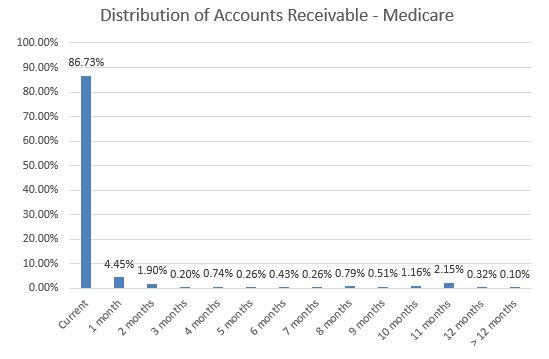
The following graph shows aging accounts receivable for the Medicare payer. As we see from the graph, over 90% of the receivables are less than two months old.
In contrast, here we can see the distribution of aging accounts receivable for commercial payers for the same hospice agency.
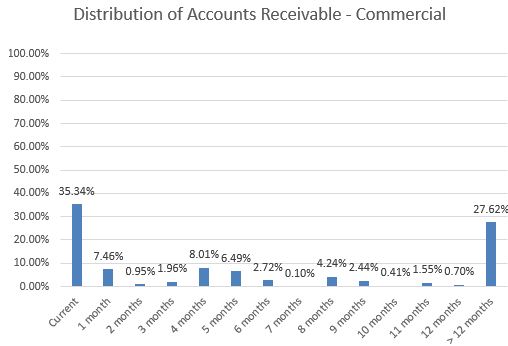
In contrast to the Medicare accounts receivables, here only 43% of the receivables are less than two months old. 25% of the receivables are between four and eight months old. More significantly, more than 25% of the outstanding receivables are more than 12 months old – a sign that there may be a high number of receivables that may have to be written off.
What is the key takeaway?
Different payers have different payment patters and different rules for timely submission of claims. Hospice agencies need to have a good understanding of the distribution of their claims and the distribution of their outstanding accounts receivable to reduce the likelihood of write-offs.

by editor | Jul 25, 2022 | Accounts Receivable, Billing, Billing - General, Financials, Metrics and KPIs
What is Aging Accounts Receivable?
The age of accounts receivable (AR) is the time that has elapsed from the time the agency delivered the service to the patient until current date. Aging AR is typically grouped into monthly buckets (e.g., 0-30 days, 31-60 days, etc.). Total dollar value of outstanding (aging) AR should be monitored each month, grouped by monthly buckets.
Consider the aging AR in the graph above. The horizontal axis shows different buckets of AR, where Medicare is the payer. “Current” represents dollars outstanding for services rendered within the most recent 30 days. “1 month” is dollars outstanding for services rendered in the most recent 31-60 days, etc. The vertical axis represents the percentage of the total Medicare dollar amounts of AR in each of the aging buckets.
How is the Accounts Receivable Distributed over Aging Buckets?
The high dollar amounts in the the first AR bucket followed by a drastic drop in outstanding AR is typical for the Medicare payer. Most agencies bill on a regular cycle (biweekly or monthly) so the large volume of outstanding AR in the “Current” bucket is mostly comprised of services that have not yet been billed out or have just been billed out to Medicare.
The outstanding AR drops but remains elevated in the “1 month” bucket. The agency is waiting to collect on services for which it has billed. It takes approximately 14 days to receive payment from Medicare. Aging AR is low in all remaining aging buckets. This is because the agency has billed and collected for most of its Medicare AR services.
What is Medicare Timely Filing?
Medicare claims must be filed no later than 12 months from the date services were provided. This includes resubmitting corrected claims that were unable to be processed. Again considering the aging AR in the graph above, note the volume of AR in the 10 month and 11 month aging buckets. AR in these aging buckets may be approaching Medicare’s timely filing deadline. Any claims in these buckets that have not yet been billed to Medicare will be not be able to be billed due to timely filing. The agency should quickly investigate the AR in these buckets.
Most agencies have a greater than 99% collection rate for Medicare AR. There should not be significant Medicare AR that is uncollectible.
In addition to monitoring total dollar value of aging AR, there are other useful classifications and breakdowns of aging AR that should be monitored on a monthly or even weekly basis.