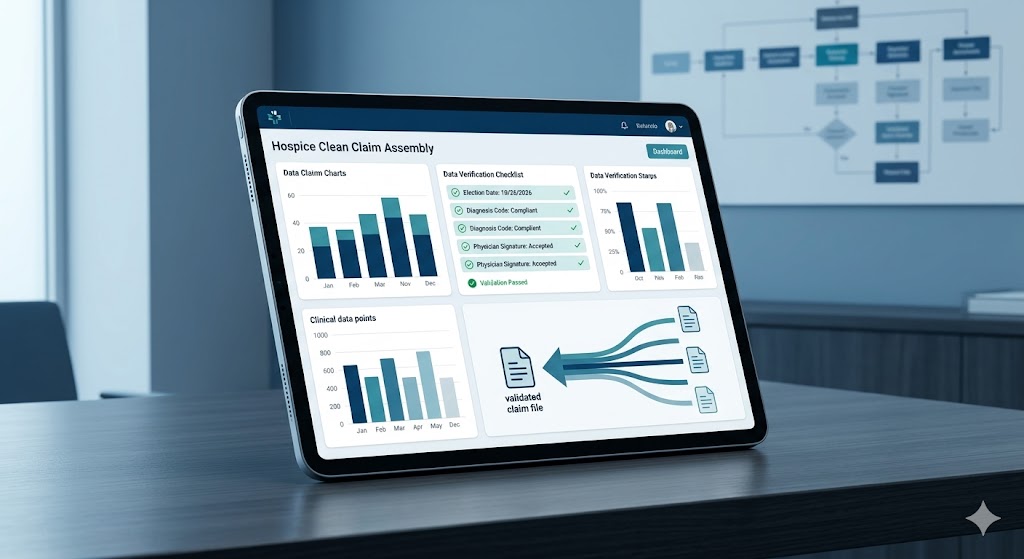
Our previous installments, Strategic Hospice Revenue Cycle Management and Hospice Billing: How to Build a Clean-Claim Process, established that a healthy revenue cycle is the engine that allows an agency to maintain stability and focus on its clinical mission. However, hospice leadership typically focus more heavily on clinical delivery rather than the financial aspects of the agency. The connection between daily administrative tasks and long-term financial health can sometimes be difficult to see.
Many leaders find that their month-end feels like a period of high volatility rather than a repeatable operating process. To shift to a more predictible financial stance, leadership must transition from merely monitoring bank balances to auditing the upstream processes that dictate the agency’s cash flow.
Hospice leadership to not need to be a billing experts to lead a successful agency. However, it is essential to have a solid understanding of the operational triggers that dictate the agency’s cash flow. To gain an understanding of the agency’s health and whether the agency is running a disciplined or reactive process, leadership can use these seven questions in the next meeting with the revenue cycle manager.
1. The “First-Pass” Health Check
The Question:“What is our first-pass clean claim rate over the last 90 days, and what are the primary reasons for failure?”
Why it matters: A “first-pass” claim is one that is paid by Medicare the very first time the agency submits it. In a healthy agency, this should be above 95%. A high first-pass rate indicates that the intake and clinical teams are providing the billing office with clean, validated data. If the first-pass rate is low, it means the billing team is spending more time “fixing” old errors than processing new revenue. A low first-pass rate means that the billing team is spending more time reworking old claims and fixing old mistakes than processing new revenue.
Leadership needs to know why claims are failing. Is it because intake forms are missing signatures? Is it because the clinical notes don’t match the billing dates? This question tells leadership which department – Intake, Clinical, or Billing – needs more training.
2. The NOE Revenue Leak
The Question:“How many non-covered days did we incur last month due to late or returned NOEs, and what was the specific dollar impact?”
Why it matters: The Notice of Election (NOE) is the most time-sensitive document in hospice. An agency has exactly five calendar days from a patient’s admission to notify Medicare. If the agency misses that window, or if the agency submits it with an error and has to resubmit it late, Medicare will simply refuse to pay for the days the agency cared for the patient prior to the NOE submission date. This is not a “delayed” payment; it is lost revenue that can never be recovered. Thus, unlike most billing errors, Notice of Election (NOE) failures typically result in permanent losses, i.e., “non-reportable” days where care was provided but cannot be reimbursed.
Tracking the dollar amount of these “non-covered days” is the fastest way to see if the agency’s intake process is disciplined. Quantifying the non-covered days in dollars transforms a “paperwork issue” into a tangible loss that requires immediate leadership intervention.
3. Sequential Discipline
The Question:“Are we experiencing out-of-sequence rejections, and if so, what is the root cause?”
Why it matters: Hospice billing is linear. Medicare processes hospice claims in a strict chronological order. An agency cannot successfully bill for a patient’s February services until the patient’s January claim has been processed and paid. This is known as sequential billing. One unclosed transfer, discharge, or revocation can halt the entire chain of claims for a patient.
Sequencing issues usually point to a breakdown in communication between field staff and the office, indicating that patient statuses are not being updated in the EMR in real-time.
If a patient’s status changes – such as a transfer from another agency, a discharge, or a readmission – the paperwork must be finalized in the system with perfect accuracy. If a single status update is forgotten or entered incorrectly, it creates a billing stoppage. Every subsequent month of revenue for that patient is held in “suspense” by Medicare until the prior month is resolved. This question reveals whether the agency’s clinical and office staff are communicating patient status changes in real-time, or if the agency’s billing department is constantly waiting on clinical data to “unlock” the next month’s cash flow.
4. The Eligibility Safety Net
The Question:“What is our 30-day forward-looking tracker for recertifications and Face-to-Face (F2F) deadlines?”
Why it matters: To keep a patient on hospice, a physician must certify their eligibility at specific intervals. For some of these, a “Face-to-Face” visit is legally required. If that visit happens even one day late, the patient’s eligibility is voided for that period, and the claim will be denied. These are unnecessary and preventable revenue lossses.
Hospice leadership should ensure that the team isn’t just reacting to missed deadlines. Instead, the team should be actively managing a calendar of upcoming recertification requirements – proactively tracking patients with upcoming recertifications – to ensure no patient “falls out of compliance.”
5. “Return to Provider” (RTP) Velocity
The Question:“What is our average ‘Time to Correct’ for claims that are Returned to Provider (RTP)?”
Why it matters: Claims are often returned for small technical errors (like a misspelled name or an incorrect ZIP code). While the error might be minor, the impact on cash flow is major. If it takes the billing team five days to notice and fix an error, the agency has effectively added five days to its “Days in AR” (the time it takes to get paid). To keep cash moving, high-performing teams aim to correct and resubmit RTPs within 24–48 hours. A high “time to correct” often indicates that the billing team lacks the necessary support from clinical leadership to resolve documentation gaps.
6. Handoff Accountability
The Question:“If you could fix one upstream process – Intake, Clinical, or Medical Director workflows – to reduce rework, which would it be?”
Why it matters: The answer to this important question gives significant insight into where “administrative friction” can be slowing down a hospice agency’s money. Billing managers often see the “symptoms” of problems that start elsewhere. For example, if the billing manager says they spend hours chasing doctors for signatures, the problem isn’t the billing – it’s the physician’s workflow.
This question breaks down operational silos. It gives the revenue cycle manager permission to identify where “dirty data” originates. Often, a minor adjustment to an admission packet or how a Medical Director receives prompts can eliminate 50% of the billing team’s manual labor.
7. The Close Process
The Question:“What is our documented ‘Month-End Close’ checklist and who owns the accountability for each handoff?”
Why it matters: The “Month-End Close” is the process of finalizing all clinical and financial data so the bills can go out. If clinical notes aren’t finished on time, the biller can’t bill. If the biller is waiting on the director to approve a report, the biller can’t bill. A clear, written checklist ensures that everyone knows their role and how it contributes to the agency’s overall ability to bill on time. Hospice leadership owns the accountability for ensuring that the clinical staff doesn’t treat documentation as an “optional” task; such an approach to documentation can delay the entire agency’s payroll and vendor payments.
When the month-end process is a mystery to everyone but the billing team, the result is process uncertainty and cash flow volatility. A disciplined system relies on a written checklist that defines when clinical notes are due, when statuses must be closed, and when the pre-bill review occurs. Accountability ensures the billing team isn’t held responsible for a clinical manager’s late paperwork.
Why This Matters for Hospice Leadership
By moving from a “scramble” to a “system,” hospice leadership protects the agency’s ability to serve patients. When the revenue cycle is predictable, leadership can stop worrying about whether payroll can be met and can start focusing on the quality of the end-of-life care that the team provides.
In our first installment on Revenue Cycle Management (RCM) – Silent Killers of Hospice Cash Flow (and How to Fix Them) – we discussed why consistent working capital is the foundation of an agency’s operational stability. It impacts staffing levels, vendor relationships, and the leadership’s ability to focus on the clinical mission.
This second installment investigates the “micro-leaks” that disrupt that stability. In hospice, financial volatility rarely stems from a single catastrophic error. More often, it is the result of repeatable administrative defects: claim rejections, late Notice of Election (NOE) filings, and chronic rework that causes accounts to sit unpaid for months.
The Anatomy of a “Clean Claim”
A clean claim is a submission that is reimbursed on the first attempt. Achieving a high first-pass pay rate is not the result of a billing team working overtime at month-end; it is the product of a repeatable system. It requires that every claim is built on accurate election documentation, verified coverage mechanics, and clinically supported eligibility before it ever reaches the billing office.
Most “dirty claims” are caused by three predictable upstream breakdowns:
Incomplete Election Packets: Missing signatures or dates that stall the billing process.
Technical NOE Failures: NOEs that are rejected (RTP) due to data entry errors, pushing the filing past the five-day window.
Sequencing Conflicts: Out-of-order billing cycles caused by uncoordinated patient transfers or discharges.
Establishing Operational Guardrails: The Three Control Points
High-performing agencies do not view billing as a back-office function that happens at the end of the month. Instead, they treat the revenue cycle as a continuous relay where each department is responsible for “passing a clean baton.” To achieve this, leadership must implement specific control points – operational “gates” that stop administrative defects before they can cascade into financial losses.
1. The Intake Gate: Securing the Revenue Foundation
The revenue cycle begins the moment a patient is referred, but the most common “micro-leaks” occur during the handoff from intake to billing. If a patient is admitted with an incomplete election packet, the agency is effectively providing care without a secured promise of reimbursement.
The Leadership Mandate: Leadership must move beyond a “get it in eventually” mindset and establish a Hard Stop Policy. This means defining exactly what constitutes a “Complete Admission.” If a signature is missing or the Notice of Election (NOE) has not been initiated within 24 hours of admission, the process should be flagged for immediate intervention. By treating the intake gate as a non-negotiable requirement, you ensure that 100% of your census is backed by an accepted NOE within the 48-hour window.
2. The Eligibility Gate: Synchronizing Clinical and Financial Data
Hospice is unique because its reimbursement is tied to strict clinical timelines, such as Face-to-Face (F2F) encounters and benefit period recertifications. In many agencies, these clinical requirements are tracked in a silo, only surfacing as a “billing problem” when a claim is held at month-end.
The Leadership Mandate: To protect audit integrity, leadership must insist on a centralized, real-time tracking system that bridges the gap between clinical operations and the billing office. This gate ensures that every patient approaching a certification deadline has a confirmed visit scheduled and a physician signature pending. When clinical leadership and billing work in a synchronized operating rhythm, you eliminate the month-end scramble.
3. The Submission Gate: The Final Quality Review
The final control point occurs just before the claim is transmitted to Medicare. This is the Pre-Bill Review, a methodical check designed to catch “out-of-sequence” errors that frequently lead to Returned to Provider (RTP) status.
The Leadership Mandate: Mandate a “double-check” protocol. The individual responsible for the final submission should verify that the claim sequence is intact and that all discharges or transfers from the prior month have been closed cleanly in the system. By catching technical errors here, rather than waiting for a Medicare rejection, you ensure a steady, predictable flow of cash.
Operational Control Summary
Use the following framework to evaluate your internal discipline and identify where your current “gates” may be failing:
Control Point
Leadership Requirement
Weekly KPI Metric
Intake/Admission
Formal definition of a “complete” packet.
Active patients without an accepted NOE.
Eligibility
Single owner for F2F and Recert tracking.
Patients with deadlines in the next 15 days.
Submission
Mandatory pre-bill sequence check.
Percentage of claims requiring resubmission.
Executive Questions for the Billing Manager
You do not need to be a billing expert to lead the revenue cycle but you do need to ask the right questions to determine if you have a stable system or a constant scramble:
On Performance: What is our “first-pass clean claim rate” for the last 90 days, and what are the top three reasons for rejection?
On NOEs: How many non-payable days did we incur last month due to late or returned NOEs?
On Sequencing: What is the root cause of our out-of-sequence issues? (Is it intake, discharge workflow, or claim timing?)
On Prevention: If you could fix one upstream process to reduce your team’s rework by 50%, which one would it be?
The Result: Predictable Cash Flow
Clean claims are not a “billing achievement”; they are the result of leadership decisions and enforced operating discipline. When NOE acceptance is reviewed daily and eligibility is tracked proactively, avoidable denials drop, and the agency moves toward a truly predictable operating rhythm.
No hospice leader enters this field because they love claims and remittances. Their focus is not hospice cash flow optimization. Hospice leadership’s goal is to ensure a dignified end-of-life journey for patients and families. They work to build an organization that can reliably deliver compassionate care, 24/7, without “behind the scenes” chaos.
However, the operational reality is simple: Clinical excellence requires financial oxygen. Even agencies with a strong census and elite clinical teams can be squeezed by delayed claims, avoidable denials, and a collections process that is only “handled when we have time.” When the revenue cycle lags, it isn’t just a billing issue; it is a threat to the agency’s staffing stability, vendor relationships, and ultimately, the patient experience.
The operational reality is that hospice revenue cycle management is the engine that keeps care moving. This blog is the first in a series designed for hospice leadership who want to move their financial operations from a state of constant triage to a predictable operating rhythm.
The Three Pillars of Hospice Financial KPIs for Leadership
To achieve true hospice cash flow optimization, leadership must move from a reactive to a proactive stance. Confusion in the revenue cycle often stems from a lack of accountability. To effectively manage the pipeline, leadership must distinguish between three distinct functions:
Billing (Accuracy & Compliance): The front-end process of generating clean claims. This includes timely filing of the Notice of Election (NOE). In hospice, a late NOE isn’t just a delay. It can result in non-payable days that can never be recovered.
Collections (Velocity and Resolution): The engine that turns claims into cash. This involves payer-facing follow-up: resolving rejections, correcting errors, and appealing denials. It is not about calling families; it is about holding insurance providers accountable.
Accounts Receivable Management (Visibility and Strategy): The dashboard used to monitor the money the agency has earned but not yet received. Effective AR management allows leadership to see if the agency is waiting on payers or if the team is waiting on itself.
Proactive vs. Reactive Operations
A healthy hospice agency doesn’t just “bill;” it runs a disciplined cycle. The table below can be used to evaluate where an agency currently stands:
Phase
Reactive Agency (At-Risk)
Proactive Agency (High-Performing)
Intake & Election
NOEs filed near the 5-day deadline; high risk of non-payment.
NOEs filed within 24–48 hours; zero “non-payable” days.
Documentation
Clinicians chasing signatures for 30-day-old claims.
“Done in a Day” culture; documentation billing-ready in 72 hours.
Payer Follow-up
Working the “loudest” payer or only the oldest claims.
Automated work queues prioritizing high-dollar and high-probability claims.
Leadership Review
Reviewing AR only when the bank balance feels “tight.”
Weekly KPI reviews that predict cash flow 30 days out.
End Result
Constant Triage: Staff is burnt out and cash is unpredictable.
The biggest threats to an agency usually aren’t dramatic disasters. They are repeatable breakdowns that quietly drain agency bandwidth:
Stalled Clinical Handoffs: A lack of “billing-ready” documentation at the point of care is a primary driver of aging AR. When the billing team is faced with clinical documentation integrity concerns leaving them unable to process a claim due to missing elements, the task is sent back to the clinician. This not only delays payment but also increases the administrative overhead per patient, as the same chart must be touched multiple times before it can be finalized
Preventable Technical Denials: The 5-day filing window for the Notice of Election (NOE) is a critical compliance threshold. If the intake process is not airtight, the agency effectively provides unreimbursable care. These technical denials represent a permanent loss of revenue that cannot be recovered through the appeals process, directly impacting the agency’s bottom line.
Unapplied Cash and Posting Delays: When payments are received but not timely reconciled within the billing system, the accounts receivable data becomes distorted. This “hidden” AR leads leadership to make strategic decisions based on inaccurate financial reports, often resulting in the team chasing resolved items while legitimate denials remain unaddressed.
Unmonitored Medicare Cap Liability: Without a proactive monthly monitoring process, the aggregate cap can become a significant, unforeseen year-end liability. Failing to track the relationship between patient stays and reimbursement levels can lead to a repayment demand that exceeds the agency’s available margins, threatening long-term operational stability.
What “Good” Looks Like: Making RCM Boring
In hospice revenue cycle management, the goal is not heroics. It is predictability. “Good” looks like a billing cadence that is “boring” in the best possible way. It means the work is driven by repeatable, auditable habits rather than last-minute scrambles. When the revenue cycle is boring, leadership meetings can focus on growth and quality rather than “Where is the cash?”
The Executive Dashboard That Leadership Should Trust
Hospice leadership does not need to be a billing experts but they do need a credible set of numbers. Every hospice leader should have weekly visibility into:
Days in AR: Is the agency getting paid faster or slower than last month?
The 90-Day Bucket: What percentage of money is drifting toward a write-off?
Clean Claim Rate: How often is billing right the first time?
Time to Bill: How many days pass between the end of the month and the first claim submission?
Five Actions Leadership Can Immediately Take
Improving the agency’s revenue cycle does not require a total overhaul. Leadership can take action to increase visibility and control starting today:
Designate One Owner: Assign a single individual to own the end-to-end pipeline from “Admission to Cash.”
Audit the Aging: Pull a one-page AR report by payer. If AR over 90 days is >15%, there is likely a process breakdown.
Identify Top 3 Drivers: Ask the team: “What are the three most common reasons claims are being rejected right now?”
Set a “Touch” Rule: Implement a rule that any claim over 45 days must be touched and documented weekly until resolved.
Schedule a 30-Minute Rhythm: Schedule a weekly revenue cycle review. Focus on patterns and removing blockers for the team.
Financial stability is the foundation of compassionate care. By moving from a reactive to a proactive revenue cycle, leadership can ensure that the agency’s focus remains exactly where it belongs: on the patient.
Hospice has always been rooted in human presence: symptom relief, careful listening, emotional support, and the work of helping patients and families live meaningfully in the time that remains.
That should not change.
But if hospice is truly about quality of life, then it is worth asking a serious question: What kinds of technologies – especially non-traditional ones – can meaningfully improve quality at the end of life?
Not every innovation belongs in hospice. Some technologies add burden, distract from what matters, or create false expectations. But others can extend what hospice has always tried to protect: comfort, autonomy, connection, dignity, and relief from suffering.
That is the real standard.
In hospice, suffering is rarely only physical. A patient may be medically comfortable and still feel confined, isolated, disconnected from identity, or unable to participate in the experiences that once made life meaningful. The most compelling role for non-traditional technology is not that it makes care look modern. It is that, in the right circumstances, it may help relieve forms of suffering that medication and routine workflows do not fully reach.
Virtual Reality: Restoring Experience When the Body Can No Longer Cooperate
One of the most promising non-traditional tools in hospice is virtual reality (VR).
For many patients at the end of life, the world becomes physically smaller. They may be bedbound, oxygen-dependent, too weak to travel, or unable to tolerate the effort of leaving their room. That loss is more than inconvenience. It often represents the loss of agency, pleasure, novelty, and access to the places that shape identity.
VR can help address that specific form of suffering.
A 2026 mixed-methods study published in the Journal of Palliative Medicine examined a VR program for veterans receiving inpatient hospice and palliative care. The study included 25 veterans with complex medical and psychiatric comorbidities. Despite some logistical challenges, 91% reported enjoying the experience and 90% said they would participate again. Travel experiences were especially popular, allowing patients to revisit meaningful places, explore “bucket-list” destinations, and engage in reminiscence even while bedbound. The authors concluded that VR showed promise for meaningful engagement, improved psychological well-being, and increased opportunities for socialization and reminiscence in end-of-life care.
These factors are extremely important because hospice quality is not only about reducing pain scores. It is also about preserving the ability to experience:
pleasure
memory
novelty
emotional uplift
personal identity
a sense of “elsewhere” beyond the illness
In the hospice setting, the most appropriate use is usually passive VR, not complex interactive gaming. Guided travel, nature immersion, spiritual spaces, music-linked experiences, or place-based reminiscence are more accessible for patients with weakness, fatigue, tremor, delirium risk, or cognitive limitations.
Used thoughtfully, VR is not simply entertainment. It can function as a quality-of-life intervention that restores experience when the body can no longer cooperate.
Wearables and Continuous Monitoring: Moving from Crisis Response to Earlier Recognition
A second category of non-traditional technology is wearable and continuous physiologic monitoring.
Traditional hospice care often depends on periodic assessment: a nurse visit, a caregiver phone call, a family observation, or a patient’s own report of worsening symptoms. That model works well in many cases but it can miss subtle decline between visits – especially in home hospice or in medically fragile patients whose symptoms escalate quickly.
Wearable sensors and ambient monitoring systems aim to fill that gap.
These technologies may track:
respiratory rate
heart rate
movement or immobility
sleep disruption
physiologic patterns that may precede visible distress
The promise is not that a device can “detect suffering” on its own. It is that it may identify patterns associated with decline or symptom escalation earlier than usual observation alone.
A 2025 pilot study in BMC Palliative Careexplored wearable sensor technology in hospitalized palliative patients. The authors found that continuous monitoring was technically feasible in some respects, especially for heart rate and respiratory rate, The study also reported significant limitations, including recruitment difficulty and incomplete data capture. Only seven patients were ultimately enrolled after early study termination. The authors concluded that while the concept is promising, it is not ready for routine clinical recommendation without further refinement.
That is exactly the right lens for hospice.
The role of wearables in end-of-life care should not be universal surveillance or gadget-driven medicine. It should be targeted support, especially where the goal is to:
recognize symptom change sooner
reduce avoidable crises
support family caregivers who are unsure what they are seeing
improve awareness between visits or overnight
prompt earlier clinician outreach or medication adjustment
In home hospice, families often carry the burden of uncertainty: Is this breathing pattern normal? Is she more restless than usual? Do I call now or wait? If monitoring tools can reduce that uncertainty without creating more anxiety, they may become clinically meaningful.
But there are real cautions:
false reassurance can be dangerous
alarms can increase anxiety rather than reduce it
data without context can trigger unnecessary escalation
poorly integrated systems can burden already stretched teams
For hospice, the right role is likely selective, not routine – used when it clearly supports comfort and clinical decision-making.
Companion Technologies: Taking Loneliness Seriously Without Replacing Relationships
One of the most underrecognized forms of suffering at the end of life is loneliness.
Even when a patient is medically well managed, they may spend long stretches alone. Family may live far away, caregivers may be exhausted, and the patient may no longer have the energy for extended conversation. For some, especially those with sensory loss or limited mobility, isolation becomes a central symptom.
This is where companion technologies deserve serious consideration.
These tools include:
voice-based companion systems
guided conversation devices
memory-prompt platforms
personalized music and reminiscence tools
socially assistive robots designed for older adults
Two well-known examples are PARO, the therapeutic robotic seal, and ElliQ, an AI-driven companion designed for older adults. These tools have been studied more in geriatrics, dementia care, and aging-in-place contexts than in formal hospice settings. However, th overlap is clinically relevant because the target problem – social isolation, disengagement, and emotional withdrawal – is common in end-of-life care.
A 2024 paper in the Journal of Aging Research & Lifestyle described ElliQ as an AI-driven social robot intended to help reduce loneliness in older adults and discussed lessons from real-world deployment. While this is not hospice-specific evidence, it is useful as adjacent evidence for how technology can support regular prompts for conversation, activity, engagement, and emotional stimulation in populations at risk for isolation.
For hospice, the key question is not whether a device can replace a loved one. It cannot.
The better question is: Can a well-designed companion tool soften periods of silence, prompt meaningful engagement, support reminiscence, or reduce distress when human presence is intermittent?
In some cases, the answer may be yes.
Potential hospice use cases include:
guided reminiscence when family is not present
prompts for storytelling or legacy conversations
familiar music and sensory soothing
gentle orientation and reassurance for anxious patients
engagement for patients who are awake but alone for long periods
brief respite support for caregivers without leaving the patient unengaged
The ethical boundary matters. Hospice is not the place to outsource relationship. But it is a place where we should take loneliness seriously enough to consider tools that may help.
Telepresence and Digital Legacy Tools: Simple Technologies, Deep Impact
When people talk about technology in hospice, they often jump straight to AI or robotics. However, some of the most meaningful non-traditional technologies are much simpler and often more clinically relevant.
These include:
video calls that allow distant family to be present
recorded voice or video messages from grandchildren and friends
bedside digital photo displays
memory archives or “legacy libraries”
telechaplaincy or telecounseling
virtual participation in birthdays, weddings, or religious observances
These tools matter because end-of-life suffering is often tied to unfinished connection. The inability to be physically present does not erase the need for presence.
Recent research outside hospice supports the broader idea that technology-mediated connection can be clinically meaningful for older adults. A 2026 randomized clinical trial in Journal of Affective Disorders evaluated a brief, online intervention for older adults with elevated loneliness and found that the intervention was well tolerated and showed a significant reduction in loneliness at six months compared with a control condition.
Similarly, a 2025 randomized controlled trial in Aging & Mental Health found that telehealth-delivered yoga for rural older adults was feasible and acceptable, even though it did not significantly outperform the control group on loneliness outcomes. The qualitative findings still suggested meaningful benefits related to the telehealth format and social connection.
The lesson for hospice is broader than any one platform: technology can preserve participation.
A patient may not be able to attend a granddaughter’s recital, but they may still witness it live. A dying parent may not be able to travel home, but they may still see the family house one more time. A patient too weak for a full visit may still receive short, emotionally meaningful video messages that can be replayed.
That is not trivial. That is care.
The Right Clinical Question: What Kind of Suffering Are We Trying to Treat?
The biggest mistake in talking about hospice innovation is treating technology as inherently good because it is new.
That is not the right framework.
The right question is: What kind of suffering is present and can this tool meaningfully relieve it?
If a patient’s main burden is:
severe pain: expert symptom management comes first
air hunger: medication, positioning, fan therapy, and skilled assessment come first
loneliness: companion or telepresence tools may help
boredom or confinement: immersive tools like VR may help
caregiver uncertainty: selective monitoring may reduce anxiety and improve response
loss of meaning or identity: reminiscence, legacy, and spiritual technologies may support care
This is where non-traditional technologies become clinically serious. They are not gadgets in search of a problem. They are potentially useful when matched to specific forms of suffering that standard hospice care does not always fully address on its own.
That should be the standard.
Conclusion: High-Tech in Service of High-Touch Care
The future of hospice should not be defined by gadgets, dashboards, or artificial intelligence. It should be defined by whether we are willing to use every appropriate tool – traditional or non-traditional – to reduce suffering in all its forms. That includes physical suffering as well as the suffering of confinement, isolation, disconnection, unfinished experience, and uncertainty.
Virtual reality, wearables, companion systems, telepresence tools, and digital legacy platforms all deserve critical evaluation. They should not be embraced blindly but they should not be dismissed simply because they are unfamiliar.
Quality at the end of life is not only about symptom control. It is also about preserving access – to meaning, to memory, to relationship, to beauty, and to self. If a technology can help do that, then it deserves a thoughtful place in the hospice conversation. If it cannot, it should stay out of the room.
Many conversations about healthcare focus on hospitals, physicians, or emerging technologies. However, a significant portion of care in the United States occurs in a different setting: the home.
Data from a recent Pew Research Center survey highlights the scale of this shift. Millions of Americans now serve as the primary caregivers for aging parents, spouses, or relatives. This informal workforce manages a complex range of responsibilities, including:
Medication management and clinical coordination
Transportation to medical appointments
Activities of Daily Living (ADLs) such as bathing or dressing
Navigating insurance and financial oversight
In the hospice and palliative care space, the role of the family caregiver is even more critical. While hospice teams provide specialized medical expertise and emotional support, the hour-to-hour management of the patient relies almost entirely on loved ones.
The Sustainability Gap
The Pew survey also underscores the hidden costs of this model. Caregivers frequently report significant impacts on their own physical health, mental well-being, and financial stability. As the U.S. population ages and chronic illness becomes more prevalent, the demand for home-based care is outstripping the capacity of family units to provide it.
For hospice directors and clinical leads, this raises an operational challenge: If the “backbone” of the care model – the family – is strained to the breaking point, how does that affect patient outcomes and the safety of home-based hospice?
A Necessary Shift in Perspective
Family caregivers are the primary reason many patients are able to remain at home rather than in a facility. Yet, because their work is unpaid and informal, it often remains invisible in broader policy discussions.
Recognizing and supporting these caregivers isn’t just a matter of “being supportive” – it is becoming a clinical necessity. As we look toward the future of healthcare, the sustainability of the family caregiving model may be one of the most significant challenges facing the hospice industry.
Used to monitor number of Google Analytics server requests when using Google Tag Manager
1 minute
__utmv
Contains custom information set by the web developer via the _setCustomVar method in Google Analytics. This cookie is updated every time new data is sent to the Google Analytics server.
2 years after last activity
__utmx
Used to determine whether a user is included in an A / B or Multivariate test.
18 months
_ga
ID used to identify users
2 years
_gali
Used by Google Analytics to determine which links on a page are being clicked
30 seconds
_ga_
ID used to identify users
2 years
_gid
ID used to identify users for 24 hours after last activity
24 hours
__utma
ID used to identify users and sessions
2 years after last activity
__utmt
Used to monitor number of Google Analytics server requests
10 minutes
__utmb
Used to distinguish new sessions and visits. This cookie is set when the GA.js javascript library is loaded and there is no existing __utmb cookie. The cookie is updated every time data is sent to the Google Analytics server.
30 minutes after last activity
__utmc
Used only with old Urchin versions of Google Analytics and not with GA.js. Was used to distinguish between new sessions and visits at the end of a session.
End of session (browser)
__utmz
Contains information about the traffic source or campaign that directed user to the website. The cookie is set when the GA.js javascript is loaded and updated when data is sent to the Google Anaytics server
6 months after last activity
_gac_
Contains information related to marketing campaigns of the user. These are shared with Google AdWords / Google Ads when the Google Ads and Google Analytics accounts are linked together.