
Hospice has always been rooted in human presence: symptom relief, careful listening, emotional support, and the work of helping patients and families live meaningfully in the time that remains.
That should not change.
But if hospice is truly about quality of life, then it is worth asking a serious question: What kinds of technologies – especially non-traditional ones – can meaningfully improve quality at the end of life?
Not every innovation belongs in hospice. Some technologies add burden, distract from what matters, or create false expectations. But others can extend what hospice has always tried to protect: comfort, autonomy, connection, dignity, and relief from suffering.
That is the real standard.
In hospice, suffering is rarely only physical. A patient may be medically comfortable and still feel confined, isolated, disconnected from identity, or unable to participate in the experiences that once made life meaningful. The most compelling role for non-traditional technology is not that it makes care look modern. It is that, in the right circumstances, it may help relieve forms of suffering that medication and routine workflows do not fully reach.
Virtual Reality: Restoring Experience When the Body Can No Longer Cooperate
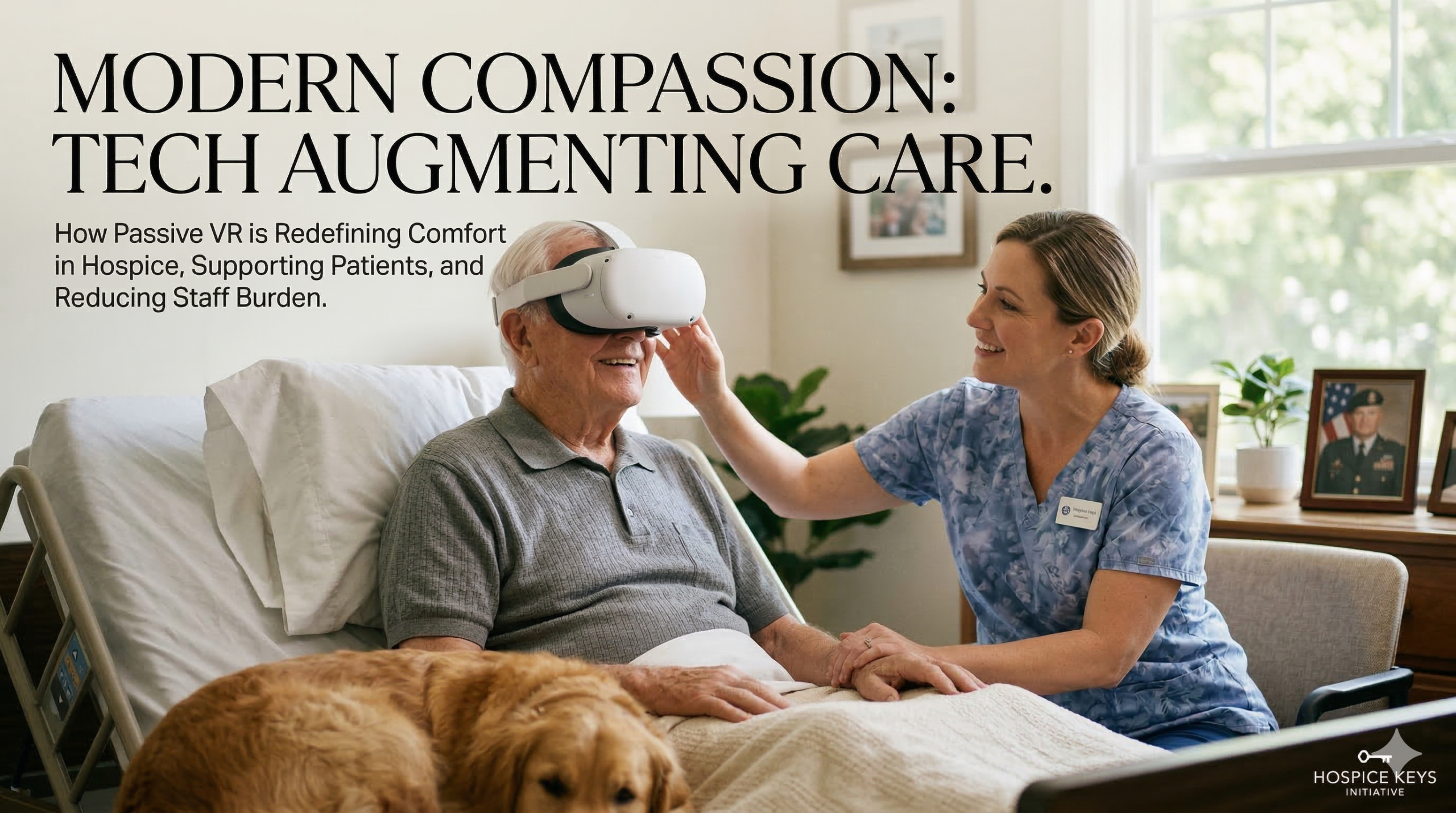
One of the most promising non-traditional tools in hospice is virtual reality (VR).
For many patients at the end of life, the world becomes physically smaller. They may be bedbound, oxygen-dependent, too weak to travel, or unable to tolerate the effort of leaving their room. That loss is more than inconvenience. It often represents the loss of agency, pleasure, novelty, and access to the places that shape identity.
VR can help address that specific form of suffering.
A 2026 mixed-methods study published in the Journal of Palliative Medicine examined a VR program for veterans receiving inpatient hospice and palliative care. The study included 25 veterans with complex medical and psychiatric comorbidities. Despite some logistical challenges, 91% reported enjoying the experience and 90% said they would participate again. Travel experiences were especially popular, allowing patients to revisit meaningful places, explore “bucket-list” destinations, and engage in reminiscence even while bedbound. The authors concluded that VR showed promise for meaningful engagement, improved psychological well-being, and increased opportunities for socialization and reminiscence in end-of-life care.
These factors are extremely important because hospice quality is not only about reducing pain scores. It is also about preserving the ability to experience:
- pleasure
- memory
- novelty
- emotional uplift
- personal identity
- a sense of “elsewhere” beyond the illness
In the hospice setting, the most appropriate use is usually passive VR, not complex interactive gaming. Guided travel, nature immersion, spiritual spaces, music-linked experiences, or place-based reminiscence are more accessible for patients with weakness, fatigue, tremor, delirium risk, or cognitive limitations.
Used thoughtfully, VR is not simply entertainment. It can function as a quality-of-life intervention that restores experience when the body can no longer cooperate.
Wearables and Continuous Monitoring: Moving from Crisis Response to Earlier Recognition
A second category of non-traditional technology is wearable and continuous physiologic monitoring.
Traditional hospice care often depends on periodic assessment: a nurse visit, a caregiver phone call, a family observation, or a patient’s own report of worsening symptoms. That model works well in many cases but it can miss subtle decline between visits – especially in home hospice or in medically fragile patients whose symptoms escalate quickly.
Wearable sensors and ambient monitoring systems aim to fill that gap.
These technologies may track:
- respiratory rate
- heart rate
- movement or immobility
- sleep disruption
- physiologic patterns that may precede visible distress
The promise is not that a device can “detect suffering” on its own. It is that it may identify patterns associated with decline or symptom escalation earlier than usual observation alone.
A 2025 pilot study in BMC Palliative Care explored wearable sensor technology in hospitalized palliative patients. The authors found that continuous monitoring was technically feasible in some respects, especially for heart rate and respiratory rate, The study also reported significant limitations, including recruitment difficulty and incomplete data capture. Only seven patients were ultimately enrolled after early study termination. The authors concluded that while the concept is promising, it is not ready for routine clinical recommendation without further refinement.
That is exactly the right lens for hospice.
The role of wearables in end-of-life care should not be universal surveillance or gadget-driven medicine. It should be targeted support, especially where the goal is to:
- recognize symptom change sooner
- reduce avoidable crises
- support family caregivers who are unsure what they are seeing
- improve awareness between visits or overnight
- prompt earlier clinician outreach or medication adjustment
In home hospice, families often carry the burden of uncertainty: Is this breathing pattern normal? Is she more restless than usual? Do I call now or wait? If monitoring tools can reduce that uncertainty without creating more anxiety, they may become clinically meaningful.
But there are real cautions:
- false reassurance can be dangerous
- alarms can increase anxiety rather than reduce it
- data without context can trigger unnecessary escalation
- poorly integrated systems can burden already stretched teams
For hospice, the right role is likely selective, not routine – used when it clearly supports comfort and clinical decision-making.
Companion Technologies: Taking Loneliness Seriously Without Replacing Relationships
One of the most underrecognized forms of suffering at the end of life is loneliness.
Even when a patient is medically well managed, they may spend long stretches alone. Family may live far away, caregivers may be exhausted, and the patient may no longer have the energy for extended conversation. For some, especially those with sensory loss or limited mobility, isolation becomes a central symptom.
This is where companion technologies deserve serious consideration.
These tools include:
- voice-based companion systems
- guided conversation devices
- memory-prompt platforms
- personalized music and reminiscence tools
- socially assistive robots designed for older adults
Two well-known examples are PARO, the therapeutic robotic seal, and ElliQ, an AI-driven companion designed for older adults. These tools have been studied more in geriatrics, dementia care, and aging-in-place contexts than in formal hospice settings. However, th overlap is clinically relevant because the target problem – social isolation, disengagement, and emotional withdrawal – is common in end-of-life care.
A 2024 paper in the Journal of Aging Research & Lifestyle described ElliQ as an AI-driven social robot intended to help reduce loneliness in older adults and discussed lessons from real-world deployment. While this is not hospice-specific evidence, it is useful as adjacent evidence for how technology can support regular prompts for conversation, activity, engagement, and emotional stimulation in populations at risk for isolation.
For hospice, the key question is not whether a device can replace a loved one. It cannot.
The better question is: Can a well-designed companion tool soften periods of silence, prompt meaningful engagement, support reminiscence, or reduce distress when human presence is intermittent?
In some cases, the answer may be yes.
Potential hospice use cases include:
- guided reminiscence when family is not present
- prompts for storytelling or legacy conversations
- familiar music and sensory soothing
- gentle orientation and reassurance for anxious patients
- engagement for patients who are awake but alone for long periods
- brief respite support for caregivers without leaving the patient unengaged
The ethical boundary matters. Hospice is not the place to outsource relationship. But it is a place where we should take loneliness seriously enough to consider tools that may help.
Telepresence and Digital Legacy Tools: Simple Technologies, Deep Impact
When people talk about technology in hospice, they often jump straight to AI or robotics. However, some of the most meaningful non-traditional technologies are much simpler and often more clinically relevant.
These include:
- video calls that allow distant family to be present
- recorded voice or video messages from grandchildren and friends
- bedside digital photo displays
- memory archives or “legacy libraries”
- telechaplaincy or telecounseling
- virtual participation in birthdays, weddings, or religious observances
These tools matter because end-of-life suffering is often tied to unfinished connection. The inability to be physically present does not erase the need for presence.
Recent research outside hospice supports the broader idea that technology-mediated connection can be clinically meaningful for older adults. A 2026 randomized clinical trial in Journal of Affective Disorders evaluated a brief, online intervention for older adults with elevated loneliness and found that the intervention was well tolerated and showed a significant reduction in loneliness at six months compared with a control condition.
Similarly, a 2025 randomized controlled trial in Aging & Mental Health found that telehealth-delivered yoga for rural older adults was feasible and acceptable, even though it did not significantly outperform the control group on loneliness outcomes. The qualitative findings still suggested meaningful benefits related to the telehealth format and social connection.
The lesson for hospice is broader than any one platform: technology can preserve participation.
A patient may not be able to attend a granddaughter’s recital, but they may still witness it live.
A dying parent may not be able to travel home, but they may still see the family house one more time.
A patient too weak for a full visit may still receive short, emotionally meaningful video messages that can be replayed.
That is not trivial. That is care.
The Right Clinical Question: What Kind of Suffering Are We Trying to Treat?
The biggest mistake in talking about hospice innovation is treating technology as inherently good because it is new.
That is not the right framework.
The right question is: What kind of suffering is present and can this tool meaningfully relieve it?
If a patient’s main burden is:
- severe pain: expert symptom management comes first
- air hunger: medication, positioning, fan therapy, and skilled assessment come first
- loneliness: companion or telepresence tools may help
- boredom or confinement: immersive tools like VR may help
- caregiver uncertainty: selective monitoring may reduce anxiety and improve response
- loss of meaning or identity: reminiscence, legacy, and spiritual technologies may support care
This is where non-traditional technologies become clinically serious. They are not gadgets in search of a problem. They are potentially useful when matched to specific forms of suffering that standard hospice care does not always fully address on its own.
That should be the standard.
Conclusion: High-Tech in Service of High-Touch Care
The future of hospice should not be defined by gadgets, dashboards, or artificial intelligence. It should be defined by whether we are willing to use every appropriate tool – traditional or non-traditional – to reduce suffering in all its forms. That includes physical suffering as well as the suffering of confinement, isolation, disconnection, unfinished experience, and uncertainty.
Virtual reality, wearables, companion systems, telepresence tools, and digital legacy platforms all deserve critical evaluation. They should not be embraced blindly but they should not be dismissed simply because they are unfamiliar.
Quality at the end of life is not only about symptom control. It is also about preserving access – to meaning, to memory, to relationship, to beauty, and to self. If a technology can help do that, then it deserves a thoughtful place in the hospice conversation. If it cannot, it should stay out of the room.


0 Comments