Artificial Intelligence (AI) is transforming the workplace. It offers immense potential for employers to enhance efficiency, decision-making, and overall performance. However, as AI is increasingly integrated into hiring decisions and other HR functions, employers must take note of the ethical and regulatory considerations that surround its use.
In this blog we review some of the potential benefits of the use of AI for employers as well as regulations considerations in using AI for hiring decisions.
Potential Benefits of AI for Employers
Enhanced Efficiency: AI can automate routine tasks, freeing up time for the HR team to focus on strategic activities. Ai can support activities such as sorting through resumes and scheduling interviews, both activities that typically consume significant resources.
Improve Decision-Making: AI systems can quickly and accurately analyze large volumes of data, providing insights that help employers make informed decisions. This includes identifying trends in employee performance, predicting future hiring needs, and optimizing workforce planning.
Bias Reduction: When properly designed and implemented, AI can help reduce unconscious bias in hiring decisions. AI can objectively evaluate candidates based on data rather than subjective impressions, leading to more fair and more inclusive hiring practices.
Cost Savings: Automating aspects of the hiring process can significantly reduce costs. AI can handle initial screenings, reducing the need for extensive human involvement until the later stages of the hiring process. The efficiency can translate into considerable savings.
Better Candidate Matching: AI-powered tools can analyze job descriptions and candidate profiles to identify the best matches, improving the quality of hires. By considering a broader range of factors, including skills, experience, and cultural fit, AI can help employers find candidates who are more likely to succeed in their roles.
Rules and Regulations Surrounding the Use of AI
While AI offers many benefits, its use in hiring is subject to various restrictions and regulations designed to ensure fairness and protect candidate rights. Employers must be aware of these to avoid legal pitfalls and ethical dilemmas.
Data Privacy Laws: Regulations like the General Data Protection Regulation (GDPR) in Europe and the California Consumer Privacy Act (CCPA) in the U.S. impose strict requirements on how personal data is collected, stored, and used. Employers must ensure that AI systems comply with these laws, particularly when handling sensitive candidate information.
Anti-Discrimination Laws: In the U.S., the Equal Employment Opportunity Commission (EEOC) enforces laws that prohibit discrimination based on race, color, religion, sex, national origin, disability, and genetic information. AI systems must be designed to comply with these laws, avoiding biases that could lead to discriminatory practices.
Transparency and Accountability: Employers must be transparent about their use of AI in hiring decisions. Candidates should be information when AI is used to evaluate their applications and employers should be prepared to explain how AI decisions are made. This transparency is crucial for building trust and ensuring fairness.
Algorithmic Fairness: AI systems must be regularly audited to ensure that they are fair and unbiased. Employers should work with AI vendors who prioritize ethical AI development and are willing to provide insights into their algorithms’ workings.
Bias Mitigation: Employers must actively work to mitigate any biases in their AI systems. This involves continuous monitoring, testing, and updating of AI algorithms to ensure they do not perpetuate or exacerbate existing biases.
Beware of Evolving Regulations
To harness the benefits of AI while navigating its regulatory landscape, employers need to keep up to date with the latest regulatory landscape and best practices related to AI in hiring. The AI regulations are evolving – and vary by jurisdictions. Employers must constantly monitor to ensure that they remain aware of the most recent regulations. Additionally, employers must regularly audit AI systems to ensure that they are fair, unbiased, and compliant with relevant laws. Finally, success will require collaboration of all stakeholders – HR, legal, and IT teams – to ensure that the AI systems that are implemented reflect a holistic approach.
Where Can You Find Out More?
Using AI to remove bias from hiring decision-making:
How can your hospice organization find out what your employees are thinking? How do you know if your employees are satisfied? Dissatisfied? How do you know if employee satisfaction varies across different agencies in your organization? Do you have a systemic problem in one of your agencies? Is one of your regions better or worse than the others?
Using employee surveys to measure employee sentiment
Hospice organizations typically conduct employee surveys to try to dig into this information. Employee surveys are prepared by the corporate office and survey the entire organization – that is – all hospice agencies across the entire organization. The surveys are typically conducted no more frequently than once per year and involve significant planning and cost. A survey response rate of 70% is considered a good response rate.
Organization may also conduct more targeted “pulse surveys” – to gather the employee sentiment on a targeted issue. Pulse surveys are run more frequently, and a 50% response rate is considered a good response rate.
Using public data sources to measure employee sentiment
However, there is another valuable source of employee sentiment that is often overlooked by hospice organizations: both current and former employees post valuable company reviews on public employment websites. These reviews provide valuable and actionable insight that can be used to monitor employee sentiment, detect trends over time, identify differences between agencies or regions in the organization and a wealth of other useful information.
How can information from public websites be used?
How can a review from a public website be used to provide insight to a hospice agency? Let’s examine some reviews to see what insight can be gained.
Data points that we can gather from this review are the following:
Rating: 5 star
Employment status: current
Date of review: March 10, 2023
Type of employment: per diem
Job role: Home recovery RN
Location: Marshfield, WI
General comments: supportive management
Here is another review:
Data points that we can gather from this review are the following:
Rating: 5 star
Employment status: former
Date of review: April 10, 2017
Type of employment: contractor
Job role: data entry
Location: Brentwood, TN
General comments: excellent company to work for
Here is a third review:
Data points that we can gather from this review are the following:
Rating: 3 star
Employment status: former
Date of review: August 1, 2021
Type of employment: full time
Job role: Patient care coordinator
Location: Vestavia Hls, AL
General comments: management does not respond to input
How can the data be stored so maximum value can be extracted?
A hospice agency should store the data in a database format – either in a database or in a spreadsheet – so that maximum value can be extracted. By storing the data in this manner, metrics of interest and can be created. Performance over time can be monitored. We provide an example below. Suppose the three reviews above are for three different locations for the same hospice organization – one for an agency located in Marshfield, WI, one for an agency located in Brentwood, TN, and one for an agency located in Vestavia Hls, AL. The data can be stored in a spreadsheet as follows:
Additional columns in the spreadsheet can be added to provide additional information. For example, categories of interest may be:
classify the employee type by categories such as clinical, corporate, office team, etc.
classify the city / state by regions in the organization.
As the number of rows in the spreadsheet grows patterns can be identified and valuable metrics can be created and monitored – in time and over time.
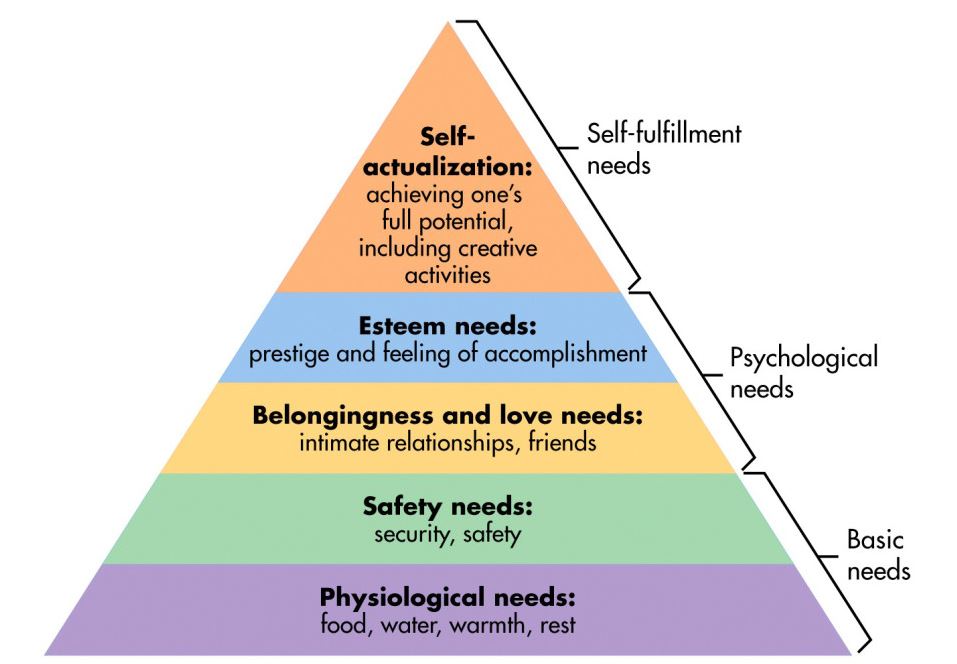
Maslow’s hierarchy of needs is a theory that can be used to provide leaders and organizations with guidance on how to motivate employees. But what is this hierarchy and what is Maslow’s theory?
What is Maslow’s Hierarchy of Needs?
Maslow developed his theory on the Hierarchy of Needs in the 1940s. The hierarchy suggests that people are first motivated to fulfill basic needs before they move on to more advanced needs.
The theory states that there are five fundamental human needs that can be represented as a pyramid. Each of the five needs builds on the prior need. Individuals want to meet needs at a lower level before progressing to needs at a higher level.
The highest-level need in Maslow’s hierarchy is self-actualization, where an individual achieves self-fulfillment.
How does Maslow’s Hierarchy of Needs relate to leadership?
A good manager understands this hierarchy of needs and leads his team so that he is meeting each employee at the employee’s current level of need while simultaneously encouraging the employee to continue to move up the pyramid so that the employee eventually achieves self-actualization. In the workplace, self-actualization translates to an employee’s desire to maximize his potential at work.
What are the levels of the hierarchy?
In Maslow’s hierarchy, Level 5 is the lowest level and Level 1 is the highest level. An individual or employee will start at a lower level and move up levels as he tries to achieve the highest level in the hierarchy.
Level 5: Psychological needs – survival
This is a most basic need for survival. Employees at this level want to feel secure that they have a steady income.
Level 4: Safety and security
Managers and leaders need to make employees feel secure. Some managers do not realize this and think that employees will work harder if they are “kept on their toes.” But this strategy usually fails. Rather than working harder, employees become obsessed with job security.
How can a leader make employees feel secure?
Communication: Share the big picture with employees.
Clear rules: Employees should know where they stand at all times
Be supportive: Support employees if they are struggling or if they fail
Be consistent: Be the same every day
Be fair
Level 3: Belonging (social needs)
Employees enjoy a team environment and a social workplace.
How can a leader create a social environment and a feeling of belonging?
Conduct team meetings
Create an area where people can gather, e.g., for coffee
Encourage a feeling that people are a part of the team
Organize social events outside of work
Level 2: Esteem/status
Employees want to be noticed, on occasion, and to stand out for their accomplishments and for what they do better than others. People like to feel important, occasionally.
How can a leader meet this need of employees to feel important?
Give employees regular recognition
Spend time with employees
Level 1: Self actualization
Self-actualization is maximizing an self-fulfillment where an individual discovers his potential and uses his skills to the utmost. This is the highest level of Maslow’s hierarchy, where employees are maximizing their potential at work.
How can a leader help employees maximize their potential?
Give employees ownership of tasks or projects
Empower employees
Help employees find ways to advance in their careers
What defines a great organization?
Maslow believes that in a great organization, employees will be at the level of self-actualization. That is, all employees must achieve Level 1. For employees to achieve Level 1, leadership must support employees through all the lower levels of the hierarchy. The pyramid will crumble if employees are lacking the supporting levels.
Further, leadership must make it possible for employees to achieve self-actualization. Employees need to be trained, to acquire new skills, and to have an environment where they gain a sense of satisfaction. A good leader will learn his employees’ potential and create an environment where people are trusted, can flourish, and are given important tasks to complete. A good leader will create an environment where employees can achieve self-actualization.
Exempt workers are paid on a salaried basis. Salaried employees receive a prespecified amount of compensation each pay period. Their salary may not be reduced because of changes in the amount of work performed or because of changes in the quality of work performed. Learn more about exempt employees here: Exempt vs. Non-Exempt Employees
May pay be deducted from an exempt employee’s wages?
Under the federal Fair Labor Standards Act (FLSA), employers may not deduct wages from an exempt employee’s wages due to partial day absences. However, an employer may deduct time from an exempt employee’s accrued Paid Time Off (“PTO”) or accrued vacation time for partial day absences. State laws may differ from the federal guidelines and each state may have its own regulations.
In general, if a salaried employee performs any work during the workweek an employer must pay the employee their full salary amount. However, there are a few situations where deduction from an exempt employee’s salary is permissible under federal law:
A workweek where an employee performs absolutely no work
The initial or final week of employment (where the employee did not work the full workweek)
Absences of one or more days due to personal reasons, other than sickness or disability, including vacation
To offset amounts the employee receives from jury or witness fees
For leave taken under Family Medical Leave Act (“FMLA”)
Unpaid disciplinary suspension of one or more days in accordance with documented workplace policies
The Fair Labor Standards Act (FLSA), enacted in 1938, has four major provisions: regulations for minimum wage, overtime pay, record keeping and child labor law. It also introduced standards for exempt and non-exempt employees. As it relates to the FLSA, exempt means free from an obligation of overtime pay. Note that FLSA regulates the Federal standards; the states may have different regulations in each of these areas.
What is an exempt employee?
Exempt employees are not eligible for minimum wage, overtime regulations, and other protections that are extended to non-exempt employees. Exempt employees receive a set salary every pay period. Exempt employees are typically salaried workers and often fill executive, supervisory, or administrative positions.
Which employees are covered under the FLSA law?
Enterprise Coverage: If a business is covered then all employees of the business are entitled to FLSA protection. What businesses are covered under enterprise coverage?
Business has at least two employees and does sales of at least 500,000
Named enterprise coverage: Hospital, business providing medical or nursing care for residents, school, preschool, or public agency, whether private or non profit
Individual Coverage: Individual employees in an organization may be entitled to FLSA protection even if the entire organization is not entitled to FLSA protection
Individual is engaged in activity that involves working across state lines (interstate business) on a regular basis
Domestic service workers (e.g., housekeeper, cook, babysitter)
Should an employee be classified as exempt or non-exempt?
An employer should consider all employees as non-exempt and overtime eligible unless they can meet a specific exemption under federal or state law
An employee who remains in the same job position should not move back and forth between exempt and non-exempt. Further, an employer cannot decide that they want to make an employee exempt. The regulations determine FLSA classification.
Job title does not determine classification
Employers must correctly classify their employees as exempt or non-exempt or they run the risk of accruing compliance violations.
Can any worker qualify as an exempt employee?
An employer may wish to classify all employees as exempt employees – in this way avoiding the requirement to pay time and a half for overtime hours worked. However, not all employees are eligible to be classified as exempt employees.
The Department of Labor (DOL) has established guidelines to determine who is eligible to be considered exempt. The qualifications generally fall into three categories: salary exemption, nature of payment, and job duties. An employee must pass the tests in all three categories to qualify for exempt status.
Exempt employees test #1: total earnings
The first test to qualify an employee for exempt status is that the employee must earn the salary threshold set by the FLSA to be exempt. The minimum salary threshold of the FLSA changes every year. In 2021, the required minimum employee compensation to have exempt status was $684 per week ($35,568 per year). This salary threshold must be met regardless of being part time or full time. If the salary threshold is not met, the employee may not be classified as exempt (with an exception for teachers, doctors, and lawyers).
Exempt employees test #2: nature of payment
The second test to qualify an employee for exempt status is that the employee must be paid on a salaried basis, where compensation is not reduced due to quantity or quality of work.
Exempt employees test #3: job duties
The third test to qualify the employee for exempt status is whether the employee meets the job duties that qualify for exempt status. There are only certain job duties that qualify an employee for exempt status. These job duties involve a higher level of expertise or knowledge or require the employee to hold certain professional roles. There are several categories of job duties exemptions:
Executive exemption: employees who would qualify for an executive exemption would
Regularly supervise employees
Be responsible for managing part of the business
Play a role in hiring employees or in delegating tasks
Administrative exemption: employees qualifying for an administrative exemption would
Perform office jobs directly related to business operations or management of the organization and its customers
Exercise independent judgement over business decisions
Professional exemption: employees qualifying for a professional exemption would
Perform job duties that require specialized education
Have a college degree or higher in their field
Computer exemption: employees with this exemption would
Have a computer related role
Outside sales exemption: employees qualifying for this exemption would
Have a primary duty of making sales or securing contracts or orders
Conduct their work outside of the business’ premises
An employer may find that an employee fails to cash a paycheck. Most often, this occurs with the final pay check. These “unclaimed wages” may not be treated as “found money.” When an employee fails to pick up a final check or fails to cash a check these unclaimed wages may become a form of “abandoned property.”
When is property considered abandoned?
Each state has its own definition of what it specifies as the abandonment period. That is, the time that each state requires that property must lay dormant before it is considered abandoned varies from state to state.
Once the unclaimed wages are considered abandoned, the employer must pay these unclaimed wages over to the state where the person last worked. The state steps into the shoes of the “lost owner” and takes ownership of the property until the rightful owner is found.
The state laws governing abandoned property are known as esheat laws because the property “escheats,” or reverts to the state and is not kept by the employer. Escheat laws are intended to give the employee an opportunity to claim the funds without having to track them down through corporate mergers or relocations,. Instead, the employee can go to the state to locate and claim the funds.
How long should an employer retain the funds?
Before an employer does anything with the unclaimed wages, the employer should check state laws to see how long the wages must be held, the employer’s obligations for locating the owner, when the employer must report the unclaimed wages to the state, and where the report must be sent to. In some states the wages are sent to the treasurer’s office. In other states the wages are sent to the attorney general’s office. States generally require that the employer holds the funds for at least one year.
Trying to locate the employee
Once an employer identifies unclaimed wages, the employer cannot simply transfer these funds to the state. The employer is obligated to make efforts to locate the employee. Employers must demonstrate that they have taken steps such as sending a tracked mailing (e.g., certified letter or UPS) to the employee’s last known mailing address or other method of contacting the employee using their last known contact information.
Most states require the employer to wait a minimum of six months after making these attempted notifications. Once the employer has complied with the statutory requirements – and can demonstrate that in the filing with the state – the funds may be returned to the state.
Reporting and remitting funds to the state
States have different reporting deadlines in the year. Some states use a date early in the following year after the dormancy requirement is met. Other states have a more accelerated deadline which would require advanced planning to ensure the deadline is not missed.
State unclaimed property laws also have detailed requirements, that vary by state, for remitting the funds to the state and for required supporting documentation.
Summing it all up: What is required of the employer?
Each state has its own unclaimed property rules and requirements.
Step 1: Document every contact you made with the employee
Most states require employers to show due diligence that they made all efforts possible to reach out to employees and give them the funds that they are owed in an attempt to keep unclaimed wages from becoming abandoned property
Step 2: File an annual report with your state
States typically require the employer to file an annual report including the employee’s name, last known address, amount and payment date of the unclaimed check, and the date of last contact with the employee
Step 3: Send the unclaimed wages with the report
With the report, the wages must be sent to the state. The state holds the money indefinitely (until claimed). The employer’s responsibility for paying the wages ends once the employer submits the wages and the report to the state.
Where can you find more information?
Recall that these laws vary by state and each state has its own requirements.
National Association of Unclaimed Property Administrators (NAUPA) webpage has links to state websites: https://unclaimed.org/
Used to monitor number of Google Analytics server requests when using Google Tag Manager
1 minute
__utmv
Contains custom information set by the web developer via the _setCustomVar method in Google Analytics. This cookie is updated every time new data is sent to the Google Analytics server.
2 years after last activity
__utmx
Used to determine whether a user is included in an A / B or Multivariate test.
18 months
_ga
ID used to identify users
2 years
_gali
Used by Google Analytics to determine which links on a page are being clicked
30 seconds
_ga_
ID used to identify users
2 years
_gid
ID used to identify users for 24 hours after last activity
24 hours
__utma
ID used to identify users and sessions
2 years after last activity
__utmt
Used to monitor number of Google Analytics server requests
10 minutes
__utmb
Used to distinguish new sessions and visits. This cookie is set when the GA.js javascript library is loaded and there is no existing __utmb cookie. The cookie is updated every time data is sent to the Google Analytics server.
30 minutes after last activity
__utmc
Used only with old Urchin versions of Google Analytics and not with GA.js. Was used to distinguish between new sessions and visits at the end of a session.
End of session (browser)
__utmz
Contains information about the traffic source or campaign that directed user to the website. The cookie is set when the GA.js javascript is loaded and updated when data is sent to the Google Anaytics server
6 months after last activity
_gac_
Contains information related to marketing campaigns of the user. These are shared with Google AdWords / Google Ads when the Google Ads and Google Analytics accounts are linked together.