
In our first installment on Revenue Cycle Management (RCM) – Silent Killers of Hospice Cash Flow (and How to Fix Them) – we discussed why consistent working capital is the foundation of an agency’s operational stability. It impacts staffing levels, vendor relationships, and the leadership’s ability to focus on the clinical mission.
This second installment investigates the “micro-leaks” that disrupt that stability. In hospice, financial volatility rarely stems from a single catastrophic error. More often, it is the result of repeatable administrative defects: claim rejections, late Notice of Election (NOE) filings, and chronic rework that causes accounts to sit unpaid for months.
The Anatomy of a “Clean Claim”
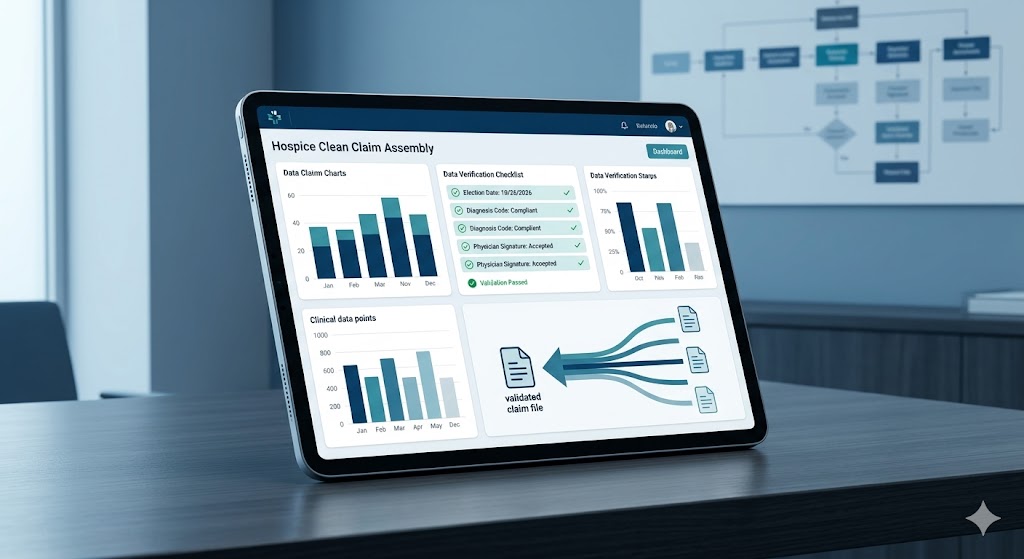
A clean claim is a submission that is reimbursed on the first attempt. Achieving a high first-pass pay rate is not the result of a billing team working overtime at month-end; it is the product of a repeatable system. It requires that every claim is built on accurate election documentation, verified coverage mechanics, and clinically supported eligibility before it ever reaches the billing office.
Most “dirty claims” are caused by three predictable upstream breakdowns:
- Incomplete Election Packets: Missing signatures or dates that stall the billing process.
- Technical NOE Failures: NOEs that are rejected (RTP) due to data entry errors, pushing the filing past the five-day window.
- Sequencing Conflicts: Out-of-order billing cycles caused by uncoordinated patient transfers or discharges.
Establishing Operational Guardrails: The Three Control Points
High-performing agencies do not view billing as a back-office function that happens at the end of the month. Instead, they treat the revenue cycle as a continuous relay where each department is responsible for “passing a clean baton.” To achieve this, leadership must implement specific control points – operational “gates” that stop administrative defects before they can cascade into financial losses.
1. The Intake Gate: Securing the Revenue Foundation
The revenue cycle begins the moment a patient is referred, but the most common “micro-leaks” occur during the handoff from intake to billing. If a patient is admitted with an incomplete election packet, the agency is effectively providing care without a secured promise of reimbursement.
The Leadership Mandate: Leadership must move beyond a “get it in eventually” mindset and establish a Hard Stop Policy. This means defining exactly what constitutes a “Complete Admission.” If a signature is missing or the Notice of Election (NOE) has not been initiated within 24 hours of admission, the process should be flagged for immediate intervention. By treating the intake gate as a non-negotiable requirement, you ensure that 100% of your census is backed by an accepted NOE within the 48-hour window.
2. The Eligibility Gate: Synchronizing Clinical and Financial Data
Hospice is unique because its reimbursement is tied to strict clinical timelines, such as Face-to-Face (F2F) encounters and benefit period recertifications. In many agencies, these clinical requirements are tracked in a silo, only surfacing as a “billing problem” when a claim is held at month-end.
The Leadership Mandate: To protect audit integrity, leadership must insist on a centralized, real-time tracking system that bridges the gap between clinical operations and the billing office. This gate ensures that every patient approaching a certification deadline has a confirmed visit scheduled and a physician signature pending. When clinical leadership and billing work in a synchronized operating rhythm, you eliminate the month-end scramble.
3. The Submission Gate: The Final Quality Review
The final control point occurs just before the claim is transmitted to Medicare. This is the Pre-Bill Review, a methodical check designed to catch “out-of-sequence” errors that frequently lead to Returned to Provider (RTP) status.
The Leadership Mandate: Mandate a “double-check” protocol. The individual responsible for the final submission should verify that the claim sequence is intact and that all discharges or transfers from the prior month have been closed cleanly in the system. By catching technical errors here, rather than waiting for a Medicare rejection, you ensure a steady, predictable flow of cash.
Operational Control Summary
Use the following framework to evaluate your internal discipline and identify where your current “gates” may be failing:
| Control Point | Leadership Requirement | Weekly KPI Metric |
| Intake/Admission | Formal definition of a “complete” packet. | Active patients without an accepted NOE. |
| Eligibility | Single owner for F2F and Recert tracking. | Patients with deadlines in the next 15 days. |
| Submission | Mandatory pre-bill sequence check. | Percentage of claims requiring resubmission. |
Executive Questions for the Billing Manager
You do not need to be a billing expert to lead the revenue cycle but you do need to ask the right questions to determine if you have a stable system or a constant scramble:
- On Performance: What is our “first-pass clean claim rate” for the last 90 days, and what are the top three reasons for rejection?
- On NOEs: How many non-payable days did we incur last month due to late or returned NOEs?
- On Sequencing: What is the root cause of our out-of-sequence issues? (Is it intake, discharge workflow, or claim timing?)
- On Prevention: If you could fix one upstream process to reduce your team’s rework by 50%, which one would it be?
The Result: Predictable Cash Flow
Clean claims are not a “billing achievement”; they are the result of leadership decisions and enforced operating discipline. When NOE acceptance is reviewed daily and eligibility is tracked proactively, avoidable denials drop, and the agency moves toward a truly predictable operating rhythm.
Additional References and Reading
- Hospice face-to-face guidance
- CGS hospice sequential billing


Simple yet very informative content.