Why “Rate Your Pain From 0 to 10” Is More Complex Than It Seems
November 30, 2025 · 7 min read
Pain
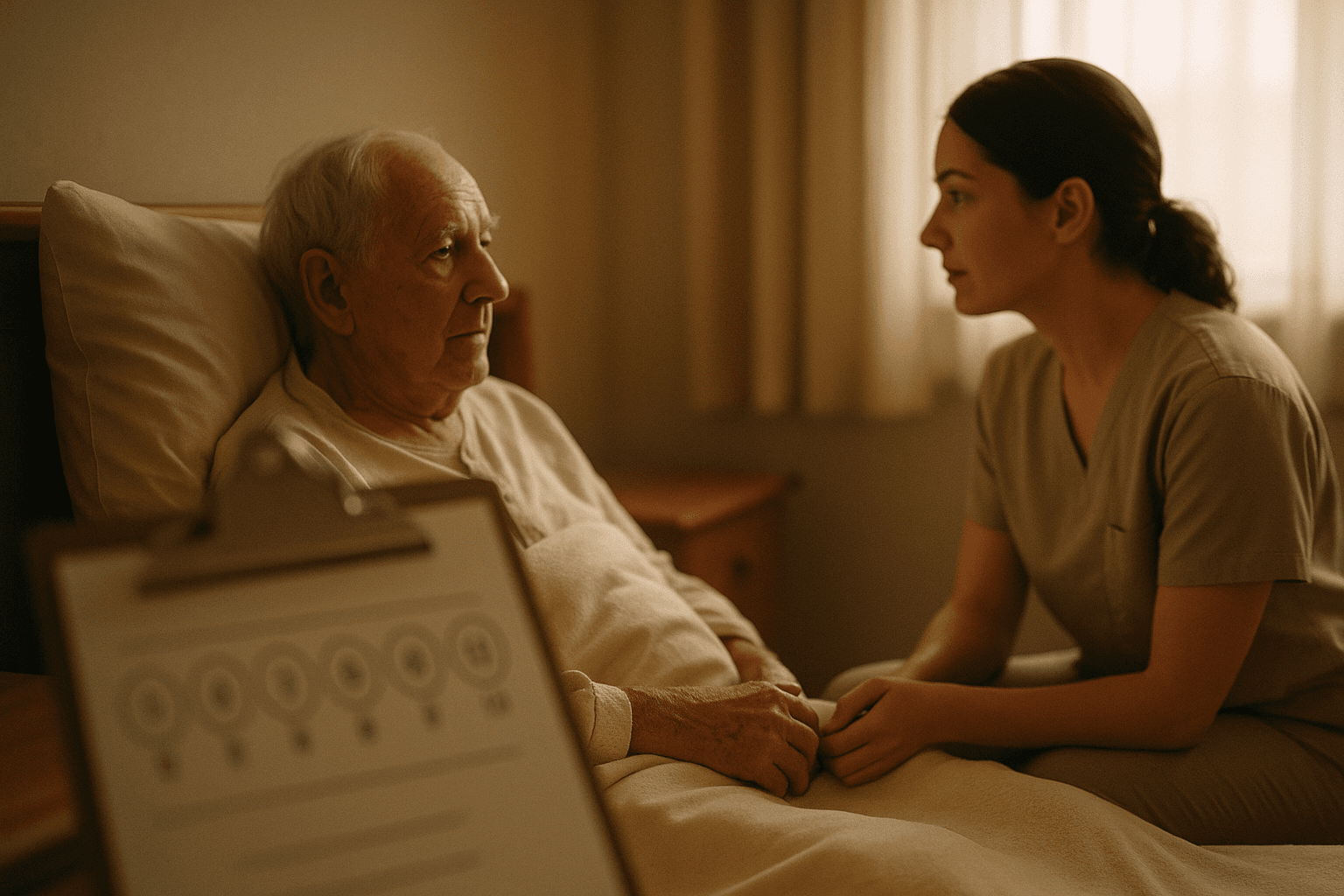
Pain assessment is foundational to clinical care, but nowhere is it more central – or more urgent – than in hospice. The familiar questions “How much pain are you in right now?” and “Is it better or worse than last week?” are routine. Yet, they are often quite difficult to answer and often yield answers that are harder to interpret than clinicians expect.
Patients frequently pause, hedge, or give numbers that appear inconsistent with clinical observations. This is not because patients are unreliable or evasive. It is because measuring pain is inherently difficult and measuring changes in pain over time is even harder. These challenges apply across all clinical settings – primary care, oncology, orthopedics, emergency medicine – but they intensify as patients near the end of life when physical decline, emotional complexity, and cognitive fluctuations overlap.
Understanding why pain scoring is difficult helps clinicians interpret patient reports more accurately, communicate more effectively, and make better decisions about comfort measures.
Why Pain Is Intrinsically Hard to Quantify
Pain is not a fixed or easily measurable quantity like blood pressure or temperature. It is a subjective, multidimensional experience shaped by tissue damage, neural sensitization, emotional state, fear, attention, sleep, cultural background, personal history, and the immediate environment. Even cognitively intact, well-rested patients must carry out several complex mental operations to answer the deceptively simple question, “What number is your pain?”
A patient must attend to sensations that fluctuate moment by moment and then map that shifting internal experience onto an abstract numerical scale that lacks any universal meaning. They must decide what constitutes “mild,” “moderate,” or “severe” for them personally, while also attempting to infer what their clinician is hoping to understand. All of this happens while the patient is experiencing the very symptom they’re trying to quantify, which can affect focus and emotional clarity.
Because the process is subjective and influenced by countless variables, two individuals with similar pain intensities may give very different ratings. Further, the same patient may provide different numbers for similar sensations on different days. A pain score is always a momentary interpretation, not a stable biological measurement.
Internal Anchors Shift – Sometimes Quickly
Pain scales assume stable reference points: zero as no pain, ten as the worst imaginable. However, patients rarely use these reference points consistently. Some patients compare to the worst pain they have ever experienced. Others, compare to what they think “bad pain” should feel like. Still others compare to how much the pain bothers them rather than how intense it is.
These internal anchors can change over time. An individual living with chronic back pain, for example, may rate what once felt like an eight as a five after months of adaptation. Another patient may give higher numbers not because the pain has intensified, but because their fear, frustration, or fatigue has increased.
These shifts are not errors. They are the natural variability of subjective reporting.
Recalling Pain and Judging Change Is Even More Challenging
If it is difficult for patients to quantify their pain in a single moment, it is even harder for them to compare today’s pain with what they felt yesterday or last week. Human memory does not store pain like a data file. It stores impressions, peaks, low points, and emotionally salient moments. A patient who had one terrible night may recall the whole week as worse than it was. Another may forget intermittent spikes because their focus is on today’s relative improvement.
When clinicians ask, “Has your pain improved since last week?”, the patient must reconstruct a past state, evaluate the present state, and make a comparison across different contexts – all while experiencing the current pain and the emotional tone that accompanies it. Research consistently shows that retrospective pain ratings only loosely match real-time daily scores.
Patients are not being inaccurate. The cognitive task itself is extraordinarily complex.
Why These Challenges Are Magnified in Hospice Care
In hospice, pain assessment becomes even more nuanced. Patients are often fatigued, medicated, cognitively altered, emotionally overwhelmed, or actively declining. Their ability to articulate subtle sensations may vary dramatically over short periods.
Pain in the hospice setting frequently coexists with breathlessness, nausea, anxiety, existential distress, and profound fatigue. These experiences are tightly woven together and any of them can alter how a patient interprets or expresses pain. As disease progresses, internal reference points change rapidly. What was once severe may later be regarded as tolerable — simply because other symptoms overshadow it.
Medication effects, such as opioids, benzodiazepines, anticholinergics, and sedatives, further alter perception, recall, and communication. Some patients underreport pain to avoid burdening loved ones. Others overreport because they fear future suffering or equate higher numbers with better symptom control. Patients may also rate their distress rather than the level of pain that they are feeling, especially when fear or loss of control is prominent.
All of this makes pain scoring in hospice not just a clinical task but a relational, emotional, and existential interaction.
Why Pain Scores Should Be Interpreted, Not Obeyed
Numerical scores should guide assessment, not dictate conclusions. Overinterpreting a single pain number can lead to unintended consequences: unnecessary dose changes, under-treatment if a patient minimizes pain, over-treatment if a patient overstates pain to express fear, or miscommunication across the care team.
A pain score of six in a relaxed, comfortable, interactive patient is meaningfully different from a six in a patient who is withdrawn, grimacing, or unable to rest. Numbers alone cannot capture that nuance.
Pain scores are most useful when viewed as starting points. Pain scores can act as prompts for deeper questioning, careful observation, and thoughtful interpretation.
Approaching Pain Assessment More Effectively
A more nuanced, clinically grounded approach benefits all patients and is especially vital in hospice. Acknowledging the difficulty of pain scoring helps patients feel understood and reduces the pressure to “get the number right.” Encouraging narrative descriptions often yields richer information than numerical ratings alone. Observing behavior, affect, respiratory patterns, posture, facial expression, and level of engagement provides essential context. These may be the primary source of information in patients who can no longer express themselves clearly.
In hospice care, family members frequently notice subtle signs of discomfort or relief that clinicians might not witness. Their insights can offer valuable directional information about how pain or distress may be evolving. When combined with trends over time rather than isolated data points, these observations support more confident and compassionate decision-making.
Function also remains important, even near the end of life. The ability to rest comfortably, participate in brief conversations, tolerate gentle repositioning, or enjoy small meaningful interactions can be as important, or more important, than reducing a pain score by a point or two.
The Heart of Effective Pain Assessment
Patients are not unreliable historians. They are human beings engaged in a fundamentally subjective and cognitively complex task. Measuring pain – and especially measuring changes in pain – requires layers of interpretation that the human brain is not designed to perform with precision. This reality does not make pain scores useless; it simply means they must be interpreted with humility, contextual awareness, and clinical judgment.
Across all settings, but particularly in hospice, pain ratings should serve as one piece of a broader, richer assessment that includes narrative, function, observation, family insight, and the clinician’s own compassionate perception.
When we recognize the complexity behind every pain rating, we improve the accuracy of our assessments and the quality of our decisions. More importantly, we enhance our capacity to provide comfort – the central promise of hospice care and one of the most meaningful goals in all of medicine.