Invisible Crisis: Rural Healthcare in a City-Centered System
December 8, 2025 · 8 min read
Death & DyingRural CareVirtual CareSafety
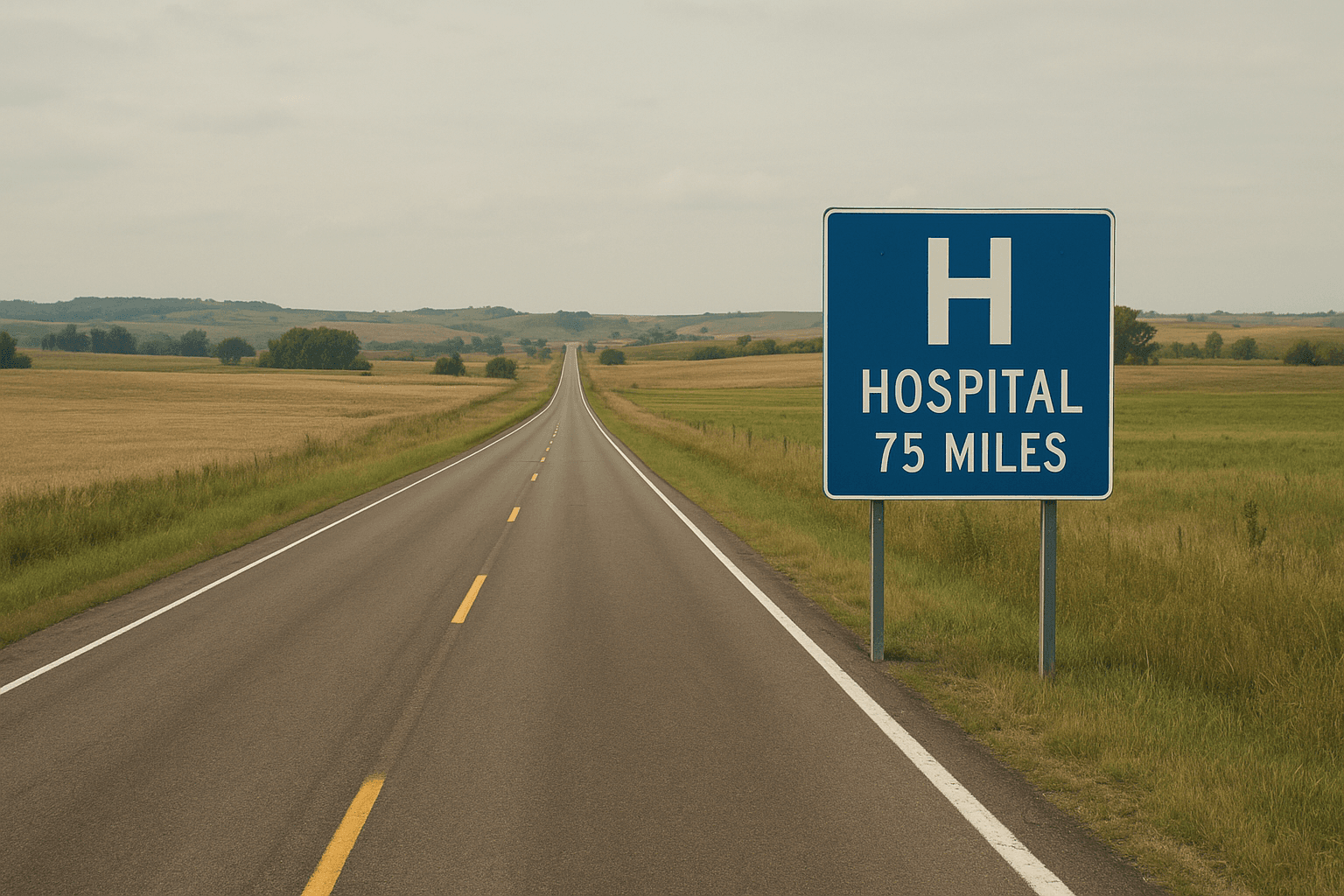
You don’t have to be a policy expert to notice something basic and uncomfortable about health care in the United States:
Your chances of getting timely, good care change a lot depending on where you live.
Roughly one in five people in the U.S. live in rural areas. Yet the system they interact with can look very different from what someone in a big city sees.
The “Rural Mortality Penalty”
Let’s start with outcomes, not opinions. Rural residents are more likely to die early from five leading causes of death: heart disease, cancer, unintentional injuries, chronic lower respiratory disease, and stroke. By 2019, death rates in rural areas were 21% higher for heart disease, 15% higher for cancer, and 48% higher for chronic lung disease compared with urban areas. Over a 20-year period, overall death rates fell in both rural and urban communities. However, rural areas never caught up to urban areas. In 2019, the age-adjusted mortality rate was about 834 deaths per 100,000 people in rural counties versus 665 per 100,000 in large metropolitan ones.
These numbers are sometimes summed up as the “rural mortality penalty”: living in a rural county is, on average, associated with a shorter life. This isn’t about rural people making worse choices or caring less about their health. It’s about what they can realistically reach and rely on when they need care.
Fewer Providers, Thinner Safety Nets
The basic building blocks of health care – doctors, nurses, clinics, hospitals – are simply less available in rural areas than in cities. Workforce data summarized by NIHCM show that urban areas have about 33 health care providers for every 10,000 people. In contrast, rural areas have only about 13 providers per 10,000. At the same time, only about 12% of physicians practice in rural communities, even though close to 20% of the U.S. population lives there. In other words, a significant share of people are depending on a much smaller pool of clinicians.
On top of that, many rural hospitals are in serious financial trouble. Between 2005 and 2023, at least 146 rural hospitals either closed or stopped providing inpatient care, and 81 of those shut down completely. An analysis from the Sheps Center counts 195 rural hospital closures or “conversions” since 2005, including 110 full closures. By 2023, about 44% of rural hospitals were operating with negative margins, compared with 35% of urban hospitals. What this means is that nearly half of rural facilities were losing money on their core operations.
When a rural hospital loses its inpatient unit or closes entirely, the impact is not theoretical. It means the nearest emergency room, intensive care unit, or surgery team is suddenly much farther away, and an already thin safety net for the community becomes even more fragile.
Maternity Care: Whole Counties With Nowhere to Go
One area where the gap between rural and metropolitan care is especially stark is maternity care. More than 2 million women of childbearing age live in U.S. counties with no maternity care at all. That means no hospital offering labor and delivery, no birth center, and no obstetric provider. These places are often referred to as “maternity care deserts.” According to the Rural Health Information Hub, about 59% of rural counties fall into this category.
Behind those numbers are very concrete realities. Pregnant people may have to drive 60 to 90 minutes or more just to get to prenatal appointments or to reach a hospital when they go into labor. Some babies are born in emergency rooms or even in ambulances because the nearest hospital with obstetric services is simply too far away to reach in time. Not surprisingly, these conditions are linked to higher risks of preterm birth, complications, and maternal deaths in the communities that lack nearby maternity care. It’s difficult to argue that we value mothers and babies equally everywhere when entire rural counties have no local place to give birth.
Not Just Distance: The Daily Friction of Getting Care
It’s tempting to think of rural health problems as “just” an issue of longer drive times. But distance interacts with everything else: work, money, childcare, energy, illness.
Some examples of what the data and reports show:
Chronic disease management
- Diabetes rates can be up to 17% higher in rural areas, and rural residents also carry heavier burdens of heart disease and lung disease.
- Managing these conditions usually requires regular checks, labs, medication adjustments, and self-management support. When the clinic is far away and appointments are limited, people are more likely to miss visits or let “routine” care slide until it becomes an emergency.
Emergency care
- Rural emergency departments cover huge geographic areas, often with limited ambulance capacity. When the nearest hospital closes, response and transport times increase, and studies associate that with worse outcomes for critical conditions like heart attacks, strokes, and major trauma.
Mental Health
- Rural communities often have very few or no local mental health clinicians. Stigma can be higher, and privacy is harder to protect in small towns. If the closest therapist or psychiatrist is hours away, it’s much easier to postpone or forgo care altogether.
None of this shows up when we only ask, “Is there a hospital in the county?” The real question is: Can people realistically use it when they need to?
Telehealth Helps – But Only If You Can Get Online
We often hear some version of: “Telehealth will solve this. People in rural areas can just see doctors on video.” Telehealth really can make a difference, especially for follow-up visits, mental health care, and specialist consults that would otherwise require long trips. But there are real limitations that show up quickly once you look at how people actually live.
During the pandemic, surveys found that more than one-third of rural residents saw broadband and computer access as major obstacles to using telehealth. Rural broadband is often slower, less reliable, or simply unavailable. Even in places where the internet technically exists, people may not have the right devices, may be limited by data plans, or may not feel comfortable using the technology in the first place. Telehealth is a helpful tool, but it doesn’t magically erase the shortage of local clinicians, the long distances to imaging or lab services, or the need for in-person care for things like labor, surgery, or acute emergencies.
This Isn’t About Blaming Rural Residents or Idolizing Cities
Of course, cities are not perfect. Plenty of people in metropolitan areas struggle to access care because of cost, insurance, racism, language barriers, or other reasons. What stands out in the rural data is the pattern:
- Fewer providers per person
- More hospital closures and service cuts
- Longer distances to basic services
- Higher rates of preventable illness and early death
So we need to ask ourselves: Are we okay with this gap being as large as it is?
Because at some level, this is not a mystery. We know rural residents are more likely to die from major causes. We know many rural counties have no maternity care. We know there are half or a third as many providers per person.
The more we learn, the harder it is to treat these differences as just an unfortunate side effect of geography.
Equity Questions to Ponder
All of this leaves us with some serious questions to ponder. These are less about policy details and more about basic fairness:
- If the data tell us that living in a rural area is linked to higher chances of dying from common, treatable conditions, what does it say about our priorities if we treat that as acceptable?
- Should good health care be thought of as something that naturally clusters in big cities, or as something every community deserves – even if it costs more per person to deliver in sparsely populated areas?
- If we’re comfortable with a system where rural residents have fewer providers, fewer hospitals, and more “care deserts,” would we be just as comfortable if the same pattern was happening systematically by race or income instead of geography?
- How far would you be willing to travel, regularly, for chemotherapy, prenatal care, dialysis, or mental health counseling? Would you be able to keep your job, care for your family, and afford those trips?
- If we were rebuilding our health system from scratch and someone proposed a plan in which rural communities consistently had worse access and worse outcomes, would we ever accept that? Or, are we primarily drifting into this situation because changing course is hard?
One does not need to be a policy expert to care about these questions. One simply needs to believe that where someone lives should not quietly decide how long and how well they get to live.
Further Reading (for readers who want to dig deeper)
- Rural Health Needs in America: Challenges & Solutions, NIHCM, 2025
- Rural Health: Addressing Barriers to Care, NIHCM, 2023
- Rural Areas Have Fewer Health Care Providers, NIHCM
- Nowhere to Go: Maternity Care Deserts Across the US, March of Dimes, 2024
- 146 rural hospitals closed or stopped providing inpatient services from 2005 to 2023 in the United States, USDA ERS, 2025
- Rural Health Disparities, Rural Health Information Hub
- Continuing Challenges in Rural Health in the United States, PMC, 2020
- Rural hospital closures and nursing home outcomes, J Rural Health, 2025
- Leading Causes of Death in Rural America, CDC, 2024