Leadership and Maslow's Hierarchy of Needs
January 29, 2023 · 3 min read
Leadership
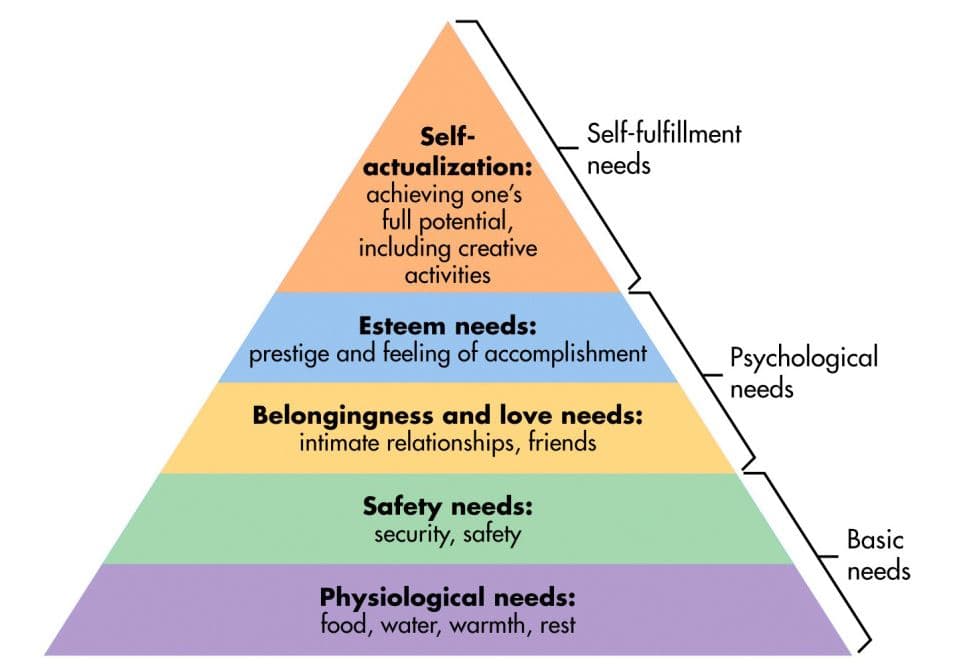
Maslow’s hierarchy of needs is a theory that can be used to provide leaders and organizations with guidance on how to motivate employees. But what is this hierarchy and what is Maslow’s theory?
What is Maslow’s Hierarchy of Needs?
Maslow developed his theory on the Hierarchy of Needs in the 1940s. The hierarchy suggests that people are first motivated to fulfill basic needs before they move on to more advanced needs.
The theory states that there are five fundamental human needs that can be represented as a pyramid. Each of the five needs builds on the prior need. Individuals want to meet needs at a lower level before progressing to needs at a higher level.
The highest-level need in Maslow’s hierarchy is self-actualization, where an individual achieves self-fulfillment.
How does Maslow’s Hierarchy of Needs relate to leadership?
A good manager understands this hierarchy of needs and leads his team so that he is meeting each employee at the employee’s current level of need while simultaneously encouraging the employee to continue to move up the pyramid so that the employee eventually achieves self-actualization. In the workplace, self-actualization translates to an employee’s desire to maximize his potential at work.
What are the levels of the hierarchy?
In Maslow’s hierarchy, Level 5 is the lowest level and Level 1 is the highest level. An individual or employee will start at a lower level and move up levels as he tries to achieve the highest level in the hierarchy.
Level 5: Psychological needs – survival
This is a most basic need for survival. Employees at this level want to feel secure that they have a steady income.
Level 4: Safety and security
Managers and leaders need to make employees feel secure. Some managers do not realize this and think that employees will work harder if they are “kept on their toes.” But this strategy usually fails. Rather than working harder, employees become obsessed with job security.
- How can a leader make employees feel secure?
- Communication: Share the big picture with employees.
- Clear rules: Employees should know where they stand at all times
- Be supportive: Support employees if they are struggling or if they fail
- Be consistent: Be the same every day
- Be fair
Level 3: Belonging (social needs)
Employees enjoy a team environment and a social workplace.
- How can a leader create a social environment and a feeling of belonging?
- Conduct team meetings
- Create an area where people can gather, e.g., for coffee
- Encourage a feeling that people are a part of the team
- Organize social events outside of work
Level 2: Esteem/status
Employees want to be noticed, on occasion, and to stand out for their accomplishments and for what they do better than others. People like to feel important, occasionally.
- How can a leader meet this need of employees to feel important?
- Give employees regular recognition
- Spend time with employees
Level 1: Self actualization
Self-actualization is maximizing an self-fulfillment where an individual discovers his potential and uses his skills to the utmost. This is the highest level of Maslow’s hierarchy, where employees are maximizing their potential at work.
- How can a leader help employees maximize their potential?
- Give employees ownership of tasks or projects
- Empower employees
- Help employees find ways to advance in their careers
What defines a great organization?
Maslow believes that in a great organization, employees will be at the level of self-actualization. That is, all employees must achieve Level 1. For employees to achieve Level 1, leadership must support employees through all the lower levels of the hierarchy. The pyramid will crumble if employees are lacking the supporting levels.
Further, leadership must make it possible for employees to achieve self-actualization. Employees need to be trained, to acquire new skills, and to have an environment where they gain a sense of satisfaction. A good leader will learn his employees’ potential and create an environment where people are trusted, can flourish, and are given important tasks to complete. A good leader will create an environment where employees can achieve self-actualization.
Where can you find more information?
- Motivating employees and Maslow’s Hierarchy of Needs
- Benefit of self-actualization on company performance
- Maslow hierarchy of needs and employee engagement