How to Submit a Notice of Election (NOE)
September 8, 2022 · 2 min read
Claims
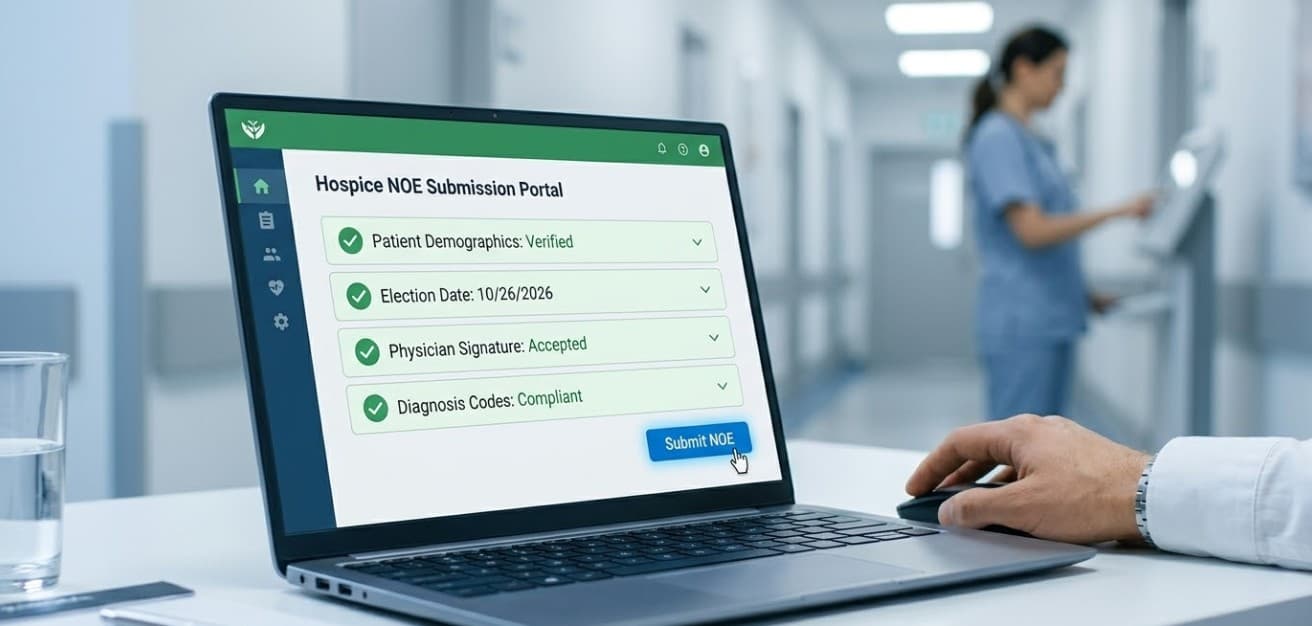
What is a Notice of Election?
When a Medicare beneficiary elects hospice services, the hospice must complete an election notice with the beneficiary and file a Notice of Election (NOE) with Medicare. A Notice of Election (NOE) is the formal mechanism used to notify Medicare that a beneficiary has elected the hospice benefit. While the concept is straightforward, the submission process requires high technical accuracy to meet the mandatory five-day filing window.
Submission Timing and the “Clean Claim” Requirement
Medicare requires that an NOE be submitted and processed before the agency files its first claim for that beneficiary. Since October 1, 2014, the standard has been strict: the NOE must be filed within five calendar days of the election date.
To satisfy this requirement, the submission must be “clean” – meaning, it is free of data entry errors. If an NOE contains errors, it is Returned to Provider (RTP). Once corrected and resubmitted, the NOE receives a new receipt date, which can push the filing outside the five-day window and result in non-covered days.
Three Methods for NOE Submission
Hospice providers currently have three avenues for submitting the NOE. Each carries different levels of administrative burden and risk of error.
1. Electronic Data Interchange (EDI) – Recommended
Effective January 1, 2018, Medicare allowed for NOE submission via EDI. This is the most efficient method for agencies seeking a predictable operating rhythm.
- The Benefit: Data is exported directly from the patient’s Electronic Medical Record (EMR), virtually eliminating manual keying errors.
- Operational Note: NOEs submitted via EDI should not be batched with standard claims; they must be processed as distinct transactions.
2. Direct Data Entry (DDE)
DDE involves manually entering the NOE into the Fiscal Intermediary Shared System (FISS).
- The Benefit: DDE provides real-time access to monitor claim status, check beneficiary eligibility, and correct errors.
- The Risk: Because this requires manual entry across multiple screens, it is highly susceptible to human error, which often leads to RTP status and potential filing delays.
3. Paper Submission (UB-04)
While technically permitted, submitting a physical UB-04 form via mail is the least efficient method.
- The Risk: This method is subject to mail delays and manual processing times at the Medicare Administrative Contractor (MAC), making it nearly impossible to guarantee compliance with the five-day window.
Ensuring Submission Accuracy
Regardless of the method chosen, the data requirements remain the same. Leadership should ensure that the billing team is utilizing verified “job aids” from their specific MAC (such as Palmetto GBA, CGS, or NGS) to ensure every data field – from the NPI to the admission date – is perfectly aligned with the election statement.
By prioritizing EDI submission, agencies can reduce their reliance on manual intervention and ensure that the “engine” of the revenue cycle remains stable and compliant.