Topological turning points across the human lifespan
December 7, 2025 · 3 min read
Research Article
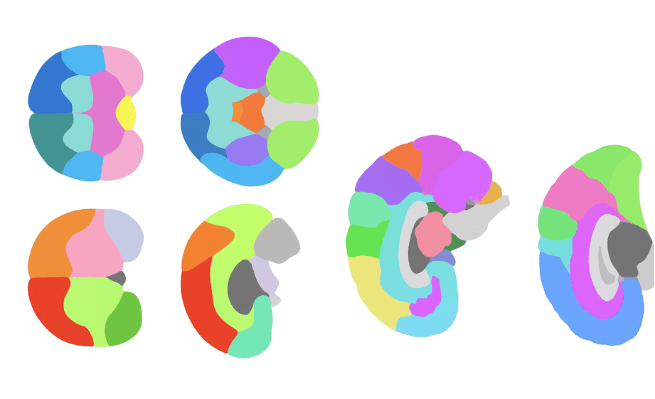
This large-scale study analyzed 4,216 diffusion MRI brain scans from individuals aged 0 to 90. The aim of the study was to map how the brain’s structural wiring – the connections that allow different regions to communicate – changes throughout the entire human lifespan. The researchers examined how efficiently the brain moves information, how much it divides into specialized subsystems, and how central or influential key regions are.
The study discovered that brain development does not unfold as a simple rise and fall. Instead, it moves through five distinct stages, each beginning at a major turning point around ages 9, 32, 66, and 83.
- From birth to age 9, the brain is rapidly reshaping and refining its connections as it builds the foundations for childhood thinking and learning.
- Between ages 9 and 32, the brain becomes more organized and coordinated, supporting the enormous growth in reasoning, emotional maturity, and independence that occurs during adolescence and early adulthood.
- From 32 to 66, changes happen more gradually as the brain settles into a long period of relative stability in structure and function.
- Between 66 and 83, the brain begins to show clearer signs of aging, with some abilities staying strong while others weaken, reflecting the uneven changes many people experience in later life.
- After age 83, the usual patterns become much less reliable. The brain’s aging process becomes highly individual, explaining why people in their late 80s and 90s often differ greatly from one another in memory, clarity, and daily functioning.
What does this mean for hospice teams?
For hospice teams, the study’s finding that the brain becomes far less predictable after age 83 may resonate deeply with clinical experience. The clinical team likely sees patients of the same age who differ markedly in cognition, awareness, engagement, emotional responsiveness, and pace of decline. This research suggests that such variability is not unusual; it is biologically expected in the final stage of life. Recognizing this invites the question:
- How might care shift if we assume that each patient’s brain is aging in its own one-of-a-kind way rather than following a standard pattern?
And because families often struggle to understand sudden changes or fluctuating cognition, it also prompts us to ask:
- In what ways can this knowledge be used to help families reframe late-life changes not as surprising inconsistencies, but as natural expressions of highly individualized brain aging?
Seeing late-life neurobiology through this lens may guide teams toward even greater patience, flexibility, and attunement.
The study also shows that from roughly ages 66 to 83, the brain becomes more modular. What this means is that certain abilities may remain strong while others weaken. For patients in hospice care (or even as people age), you often see individuals who can still pray, sing, joke, or recall childhood memories even as problem-solving, attention, or short-term memory decline. This pattern encourages us to consider:
- How can we better identify and amplify these preserved abilities to support connection, dignity, and emotional well-being?
At the same time, many family caregivers – especially adult children – are themselves navigating demanding life stages that affect their own cognitive and emotional bandwidth. Understanding the brain’s lifelong shifts raises another reflection:
- Could recognizing the developmental pressures on caregivers help us extend more empathy and support when they appear overwhelmed, conflicted, or emotionally stretched thin?
In appreciating the parallel journeys of patients and families, the team becomes better positioned to offer care that honors the full human context of end-of-life experiences.
References
- Link to full downloadable article